


When to replace spark plugs and glow plugs in the Lexus LX
Lexus LX
Lexus LX•
•19 views
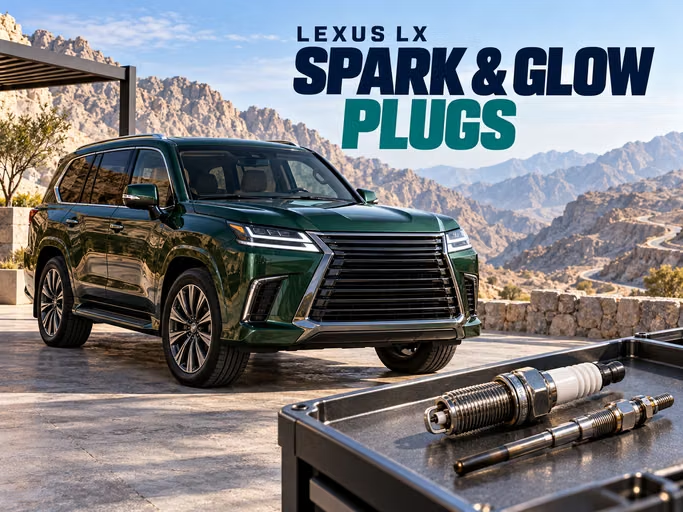
For the petrol Lexus LX 600 covered by the regional manual discussed here, spark plug replacement is scheduled every 60,000 km. This is not a universal LX interval: the LX 570, hybrid LX 700h and diesel versions require separate checks of their maintenance requirements.
Petrol engines use spark plugs; diesels use glow plugs. This guide explains how to identify the correct system, establish replacement timing and distinguish worn plugs from other causes of poor engine running.
Before ordering parts, collect the VIN, model year, engine code and service history. The LX badge and trim name are not enough: similar-looking vehicles can have different powertrains.
Which plugs does the Lexus LX use
The description on lexus.ae identifies the LX 600 as a 3.5-litre twin-turbo petrol V6. It needs spark plugs to ignite the mixture. A diesel LX uses a different system.
| Version | Powertrain | Plug type |
|---|---|---|
| LX 570 | 5.7-litre petrol V8 | Spark plugs |
| LX 600 | 3.5-litre twin-turbo petrol V6 | Spark plugs |
| LX 700h | Hybrid with a 3.5-litre petrol V6 | Spark plugs |
| LX 450d | 4.5-litre diesel V8 | Glow plugs |
| LX 500d | 3.3-litre diesel V6 | Glow plugs |
Why sets are not interchangeable between generations
The LX 570 technical description on pressroom.lexus.com specifies a 5.7-litre V8. Do not select its plugs from the LX 600 catalogue: engine design, cylinder count and component requirements differ.
The diesel LX 450d and LX 500d also require separate part selection. Inclusion in the model family does not establish availability in every local specification. For a used vehicle, confirm the installed engine and original specification first.
Does the hybrid LX 700h still need spark plugs
The hybrid-system description on global.toyota explains that an electric motor works with a petrol V6. The LX 700h therefore retains spark plugs. Its ability to run on electric power does not eliminate plug servicing.
Check the hybrid’s own maintenance documentation. Even the same advertised engine capacity in the LX 600 and LX 700h does not justify transferring a replacement interval or plug part number between them.
Which replacement interval applies
Page 523 of the LX manual on lexus.com.bh marks petrol spark plug replacement at 60,000 km. Page 520 says to continue maintenance at the same intervals beyond the table. The plug entry gives no separate limit in months.
| Version or situation | Reference | What to establish |
|---|---|---|
| LX 600 covered by this manual | Every 60,000 km | Confirm applicability by VIN |
| LX 570 and earlier LX models | Their own schedule | Do not transfer the LX 600 interval |
| Hybrid LX 700h | Its own schedule | Check hybrid documentation |
| Diesel LX models | Separate glow-system checks | Petrol mileage does not apply |
Dusty roads and heavy loads
If your LX travels on dusty roads, tows a trailer or spends long periods idling, explain its actual use to the workshop. Check the applicable additional maintenance items: a shorter interval for one operation does not mean that spark plugs need the same reduction.
Do not adopt a universal 20,000 or 30,000 km replacement interval solely because of hot weather. Rough running needs diagnosis regardless of mileage. If oil, an incorrect mixture or a faulty coil is fouling a plug, replacing the plug alone leaves the cause unresolved.
Checking a used vehicle
When browsing current offers for the Lexus LX, request plug replacement records showing dates, mileages and part numbers. A “major service” entry without an itemised work list does not confirm that the plugs were replaced.
If the history is unknown, identify the engine and applicable schedule first. Then agree the work with the workshop. Ask whether the quotation includes diagnosis and any seals required if components must be removed for access.
Signs that the plugs need attention
Jerking during acceleration, an uneven idle and difficult starting can indicate ignition problems. Injectors, air leaks and mechanical faults can produce similar symptoms. In a heavy LX, rough running under load may be especially noticeable on a climb or during acceleration, but it does not by itself prove that the plugs are worn.
| Observation | Possible explanation | What to investigate |
|---|---|---|
| Jerking during acceleration | Unstable spark or mixture | Plugs, coils and engine fuelling |
| Oil in a plug well | External leak through a seal | Leak source and coil boot |
| Oil on the firing end | Oil entering the cylinder | Oil consumption and mechanical condition |
| Dry black deposits | Fouling or poor combustion | Mixture, trip pattern and plug suitability |
| Rough running after replacement | Installation or selection error | Part numbers, insulators and connectors |
Why reading a fault code is not enough
A misfire code points towards an investigation; it does not instruct you to replace a plug. Diagnosis should account for the operating conditions and individual cylinder checks. Clearing the code without a repair leaves the cause unresolved.
The ignition troubleshooting article on ngkntk.com explains the effects of plug fouling and installation errors. An unsuitable heat range, damaged insulator or incorrect tightening can cause problems even with a new set.
If the engine shakes badly and the malfunction indicator flashes, stop accelerating and pull over safely. Running with severe misfires can damage the catalytic converter. Arrange transport to a workshop if the problem persists.
What to tell the technician
Explain when the symptom occurs: after overnight parking, with the engine warm, during acceleration or following recent servicing. Keep removed plugs in cylinder order. Differences between them can assist diagnosis, but deposit colour alone does not provide a definitive answer.
Glow plugs in diesel LX models
The LX 500d description on lexus.com.au identifies a 3.3-litre twin-turbo diesel V6. Glow plugs help create suitable conditions for diesel starting. The earlier LX 450d with its 4.5-litre V8 also uses a glow system, but its parts and procedures must be checked separately.
When to check the system
Reasons to investigate include difficult starting after parking, uneven running in the first seconds, increased smoke and preheating fault codes. A failure may be less noticeable in warm conditions. A weak battery, low compression or a fuel-system fault can produce similar symptoms.
Hot weather does not make the system unnecessary: depending on its design, heating may continue after startup. Check the actual diesel’s schedule. If no scheduled glow plug replacement is specified, use diagnosis rather than the petrol LX 600’s mileage interval to decide when replacement is needed.
Check the plug and its power supply
NGK’s technical guide on ngkntk.com describes resistance checks for glow plugs. Compare readings with the specification for the actual component. Do not connect a plug directly to the battery to test its heating: this can damage the element.
Check the wiring, connections and control module alongside the plugs. A fault in one channel may originate in the supply circuit. Replacing a working heater will not resolve that problem.
Avoiding damage during replacement
The practical fault-finding and installation guidance on denso-am.eu helps assess failure causes and fitting requirements. A replacement must match the engine’s required voltage, length, thread and heater type.
Do not keep increasing force on a seized glow plug without control. Preparation and permissible force must follow the repair procedure. If breakage is a concern, use a workshop with suitable equipment. After removal, check that the heating tip is intact.
Decide whether to replace one plug or the set after assessing the remaining components and the cause of failure. If a control-system fault caused the damage, address it first to avoid a repeat failure of the new parts.
Selecting and fitting spark plugs
Page 631 of the cited LX manual specifies DENSO EC22HPR-D7 iridium plugs with a 0.7 mm gap for its petrol engine, and says not to adjust the gap during servicing. Confirm these details against the VIN; they are not universal LX specifications.
Pre-replacement checklist
☐ Confirm the engine, quantity and plug part numbers.
☐ Switch the ignition off and prevent accidental starting, including hybrid READY mode.
☐ Allow the petrol engine to cool.
☐ Clean the wells and inspect the coils and boots.
☐ Prepare the correct socket and tightening specifications.
The installation procedure on ngksparkplugs.com calls for a cooled engine, clean wells and correct tightening. Start the plug without cross-threading; select the torque specified for the engine and component rather than a universal figure for all LX models.
Do not lubricate the threads without an explicit manufacturer instruction. Do not wire-brush fine electrodes. If a plug has been dropped or its insulator is damaged, check its suitability before fitting. The part number, heat range, thread reach and seat must match the engine.
Frequently asked questions
Should ignition coils be replaced with the plugs
There is no automatic requirement. Test coils and replace them when a defect is confirmed. During plug servicing, inspect boots and connectors and address any oil or water entering the wells.
Can you wait until the engine runs roughly
No: smooth running does not cancel scheduled maintenance. After replacement, retain the date, mileage and part numbers. If a fault was repaired, check the result under the conditions in which it occurred.
Conclusion
For the LX 600 covered by the cited manual, the replacement reference is 60,000 km. The LX 570 and LX 700h need their own schedules, while diesel LX models require separate glow-system servicing. If the engine runs poorly, establish the cause before selecting parts and agreeing repairs.


