When to change transfer case oil in a Lexus LS
Lexus LS
Lexus LS•
•13 views
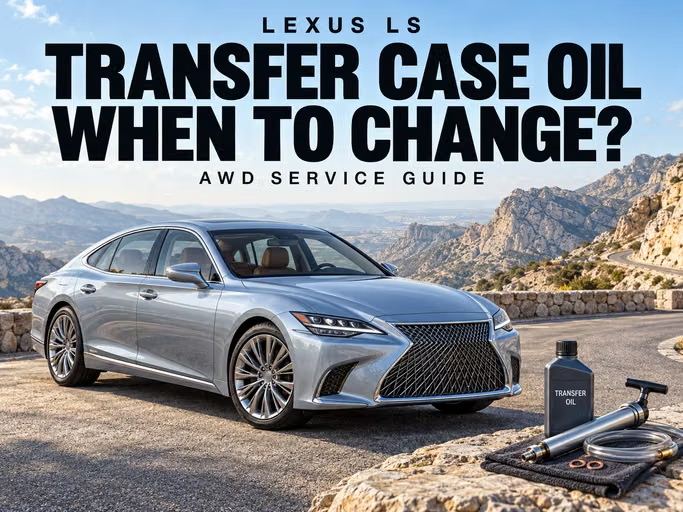
For an all-wheel-drive Lexus LS covered by the manuals reviewed here, replace transfer case oil every 40,000 km or 48 months. The listed demanding conditions shorten this to 20,000 km or 24 months. A rear-wheel-drive version has no transfer case, so confirming the vehicle’s drivetrain is the first step.
The main example is the fifth-generation LS 500 AWD. We use the LS 500 / LS 350 owner’s manual provided on lexus.ae: the schedule is on page 458, additional conditions on pages 460–462, and oil specifications on page 561. Do not automatically apply these figures to the LS 460, LS 600h or other generations.
Which LS versions have a transfer case
The transfer unit in an all-wheel-drive LS helps deliver power to both axles and is serviced separately from the transmission and differentials. A model badge, styling package or visible propeller shaft cannot replace checking the vehicle specification by VIN and inspecting the actual car.
- Rear-wheel-drive LS — no separate transfer case oil change is needed. Transmission and rear differential maintenance still applies.
- LS 500 AWD — the transfer case has its own oil specification, capacity and maintenance entry.
- LS 500h AWD — the hybrid designation does not mean that the vehicle has no transfer unit.
What matters on the hybrid LS
The separate LS 500h owner’s manual includes a Transfer (AWD models) section specifying LL 80 and 0.70 L. Its schedule on page 466 includes transfer oil inspection and replacement. Do not assume that the LS 500h uses the same AWD arrangement as a hybrid crossover simply because both carry an h badge. A rear-wheel-drive hybrid does not require this operation.
Normal and shortened intervals
The normal schedule calls for transfer oil inspection every 20,000 km or 12 months and replacement every 40,000 km or 48 months. I means inspection, with correction or replacement as necessary; R means scheduled replacement. In each case, follow whichever distance or time limit comes first.
- Replacement every 20,000 km or 24 months applies when the vehicle is mainly operated on rough, muddy or dusty roads, or with heavy loading.
- The same interval applies to continuous driving for more than two hours at 80% or more of the vehicle’s maximum speed. This is the document’s definition of an operating condition, not a recommendation on driving speed.
For the LS 500h, the corresponding additional requirements appear on pages 468–470 of its manual. Assess actual use: an occasional visit to a dusty parking area is different from regular operation on dusty roads.
Low mileage does not cancel the time limit. If the service history is unclear, request earlier invoices and agree on an initial inspection with the workshop. A general note stating “all oils changed” does not establish that the transfer case was serviced.
Which oil the transfer case requires
The Transfer (AWD models) sections of both selected manuals give the same specifications below. Before purchasing fluid, check that the document applies to the production year and fitted component.
| AWD transfer case parameter | Selected manuals’ specification |
|---|---|
| Oil | Toyota Genuine Transfer gear oil LL 80 or equivalent |
| Capacity | 0.70 L |
The listed capacity helps with preparation. Set the final level using the service procedure for the particular unit, rather than the size of the container.
Do not select LL 80 by analogy with differential oil
The AWD front differential is listed separately on the same page and requires Toyota Genuine Differential gear oil LT 75W-85 GL-5 or equivalent. This is a different specification. Servicing both components together does not make one product suitable for both.
Do not choose ATF WS, LT 75W-85 or Transfer Gear Oil LF for this transfer case because the names look familiar. Its requirement is specifically LL 80. If a workshop proposes an alternative, ask for technical information confirming the complete requirement, rather than a general “suitable for Lexus” claim.
Keep transmission, transfer case and differential capacities separate. The quote should identify each component and its fluid on a separate line. This is particularly helpful when several fluid services are completed during the same visit.
What to check during the service
Before draining, inspect the housing, seals and plugs, locate any leakage and confirm access to the filling point. If a leak is found, topping up alone is insufficient: the workshop needs to establish why the unit is losing oil.
- Use suitable seals and follow the tightening torques in the repair information.
- Check drained oil for water and unusual contamination; large particles require investigation.
- After filling, check for leaks and record the product, quantity, date and mileage on the invoice.
When not to wait for scheduled replacement
| Situation | Action |
|---|---|
| Oil leakage under the vehicle | Locate the source and check the affected unit’s fluid level |
| Humming or vibration while driving | Inspect the drivetrain and running gear and locate the source |
| Deep-water exposure or underbody impact | Inspect the housing and seals and assess fluid condition |
| Heavy leakage, banging or loss of drive | Stop safely and arrange recovery |
Owner checklist
☐ Confirm the generation, production year and VIN.
☐ Verify rear-wheel drive or all-wheel drive.
☐ Distinguish the LS 500 from the hybrid LS 500h.
☐ Find the applicable manual and Transfer entry.
☐ Check the date and mileage of previous work.
☐ Describe dust exposure, loading and other operating conditions.
☐ Agree on LL 80 and the level-setting procedure.
☐ Separate transfer case and differential work on the quote.
☐ Keep a detailed service invoice.
Common mistakes
- Scheduling a transfer case service for a rear-wheel-drive LS.
- Assuming that every hybrid has no transfer case.
- Substituting differential oil or ATF for LL 80.
- Waiting for scheduled mileage despite leakage, noise or housing damage.
Conclusion
For the LS AWD versions reviewed here, the starting replacement interval is 40,000 km or 48 months, shortened to 20,000 km or 24 months under the specified demanding conditions. Inspection is due earlier. Confirm the vehicle version, follow the LL 80 requirement and identify the work on each component clearly.
When browsing current offers for the Lexus LS, ask about the drivetrain and its service history. Records naming the fluids help establish what has been done and what maintenance may be due after purchase.