When to change brake fluid in a Land Rover Defender
Land Rover Defender
Land Rover Defender•
•9 views
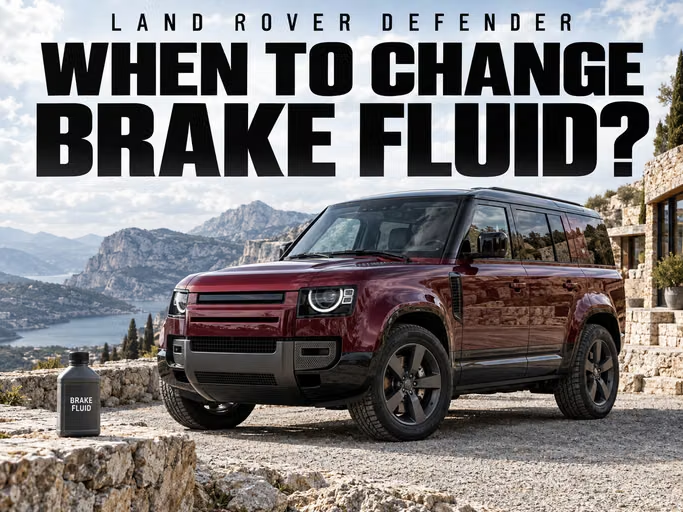
Article illustration. Vehicle and packaging details are illustrative; select brake fluid to match the requirements of the specific Defender.
The brake fluid replacement interval for a Land Rover Defender depends first on its generation and applicable service schedule. One official service document for the classic Defender specifies 24,000 miles / 40,000 km or two years, whichever comes first. That figure should not automatically be treated as the rule for a modern L663 Defender: its schedule needs to be checked for the individual vehicle.
This distinction matters particularly when buying a used example. The Defender name covers vehicles with different brake system designs, and a record saying “service completed” does not explain whether the brake fluid was changed. This article explains how to establish the due date, select the correct fluid, recognise situations that need diagnosis and understand what the workshop should record after the job.
Establish the interval for your Defender
Classic Defender
The Online service history and service intervals document on topix.landrover.jlrext.com lists 24,000 miles / 40,000 km or two years, whichever comes first, for the Defender. This is a document from the classic model’s production period. Match it against the service literature for your model year and market rather than applying it to every vehicle carrying the name.
If that schedule applies, covering only a small distance in two years does not cancel the replacement. Equally, reaching the mileage limit sooner means there is no reason to wait for the second anniversary. Calculate the due point from the date and mileage of the last documented fluid replacement, rather than from today’s odometer reading alone.
Modern L663 Defender
For the newer Defender 90, 110 and 130, ask the workshop for the VIN-specific maintenance schedule, including the separate brake fluid item. You can access the owner information through Land Rover iGuide: entering the VIN helps select information aligned with the vehicle’s market and specification. A body designation such as 110, or an engine badge, is not a substitute for identifying the vehicle properly.
When booking, ask a precise question: “When is the next brake fluid replacement due under the schedule for this VIN?” A useful answer gives both the due point and its basis: the applicable schedule and the previous replacement record. A general statement about servicing all SUVs every few years does not provide that confirmation.
Why low mileage does not prove the fluid is still suitable
Glycol-based brake fluid gradually absorbs moisture. This lowers its boiling point; under heavy heat exposure, compressible vapour bubbles can form and interfere with pressure transmission. Brembo’s explanation of brake fluid describes this mechanism. Distance travelled is therefore not the only consideration when assessing replacement needs.
For an owner, the practical implication is that gentle urban use and occasional outings do not remove the calendar requirement. If the vehicle has been parked for a long period, reconstruct its service history before a major journey. A seller’s statement that it was “hardly used” describes usage, but does not establish the condition of the fluid.
Do not wait for a noticeable change in braking before considering scheduled maintenance. A replacement schedule is intended to preserve function; an actual symptom already requires investigation. Nor should a longer pedal movement automatically be blamed on old fluid. The workshop needs to establish whether a fault is present before deciding what work will resolve it.
Do mountains, towing and off-road use change the decision
The official description of arduous operating conditions includes mountain driving, frequent trailer towing, mud and wading among situations requiring closer attention to servicing. That does not create a universal rule to replace brake fluid after every off-road trip. It does make your driving pattern relevant when discussing inspections and maintenance with the workshop.
Before travelling, explain whether the Defender will carry substantial luggage, tow a trailer or negotiate long descents. This allows the workshop to consider the brakes in the context of the planned journey, rather than only normal commuting. If a scheduled fluid change is approaching, arranging it in advance also leaves time to check the outcome before departure.
After a water crossing or muddy trail, distinguish between the condition of external brake components and the fluid inside the hydraulic system. Wet wheels alone do not establish that water entered the reservoir. If braking feels different, describe exactly when the change began and what happened immediately beforehand. That account is more useful than assuming a particular component needs replacement.
Which brake fluid should you choose
The Lubricants and fluids table in classic Defender handbook LRL 10 02 51 141 lists Shell Donax YB, Shell DOT4 ESL or a compatible synthetic fluid meeting FMVSS 116 DOT4. This is a specific example from that handbook, rather than permission to use any bottle marked DOT 4 in every Defender.
For your vehicle, compare the handbook requirements with the product’s technical information. If the workshop proposes an alternative to the fluid originally agreed, ask it to demonstrate compliance with the required specification. Descriptions such as “premium”, “sport” or “for European vehicles” do not provide that evidence.
A higher DOT number does not automatically identify a suitable upgrade. HELLA’s guidance on fluid selection and replacement stresses compatibility and the vehicle manufacturer’s requirements. A change of fluid type is therefore a technical decision, rather than an automatic way to improve braking performance.
A practical step is to have the complete product name included in the preliminary work order. This preserves the agreed specification in writing. At the next service, you will not have to reconstruct what was used from the colour of the bottle or somebody’s memory of the job.
What a falling reservoir level means
The classic Defender’s fluid level instructions explain that a small reduction can accompany brake wear, while a substantial drop requires investigation for a leak. Check on level ground by viewing the reservoir markings and comparing the level with MIN and MAX. Use the appropriate handbook for access to the reservoir on your version.
Topping up and replacing the fluid address different issues. If the level has changed noticeably, the cause needs to be established first. Filling the reservoir is not enough to declare the matter resolved. Tell the workshop when the level was last checked and whether there has been recent brake work, a warning on the instrument panel or a change in pedal movement.
Can colour or a tester tell you when replacement is due
Light-coloured fluid does not prove that a scheduled change can wait. Bosch Car Service’s explanation distinguishes a visual check from a proper condition assessment: appearance alone cannot establish whether the fluid remains suitable for use. A photograph of the reservoir is therefore no substitute for service records and inspection.
If the workshop offers a test, ask what it measures and which instrument it uses. For example, ATE’s technical documentation for testing equipment describes determining the boiling point by heating a sample. That result is different from a simple indicator’s conditional pass signal. The method matters when interpreting the reading.
Ask for the measured value, units and the technician’s conclusion to be recorded. “Checked and fine” is less informative than an understandable result. A good reading does not automatically establish a new maintenance interval, either. Any decision to move a scheduled replacement should be supported by the vehicle’s requirements, rather than by one test alone.
What a proper replacement should include
Before starting, the workshop needs to know whether this is routine maintenance or work following a repair to the hydraulic system. Mention any recent replacement of a caliper, hose or other relevant component. That history helps the technician choose the appropriate procedure and subsequent checks.
Changing only the fluid in the reservoir is not equivalent to renewing the fluid throughout the braking system. The job should follow the manufacturer’s replacement and bleeding procedure. HELLA notes that certain ABS and ESP operations may require diagnostic activation of the hydraulic unit. The presence of ABS alone does not establish one procedure for every Defender.
The owner does not need to dictate the sequence for opening bleed screws. It is more useful to confirm that the workshop follows the documentation for the actual vehicle and checks for leaks, correct level and brake function afterwards. If the pedal feels unfamiliar at handover, raise this before taking the vehicle onto the road.
Must the pads and discs be changed at the same time
Ask the workshop to list additional findings as separate jobs. A scheduled fluid change does not itself establish a need for new pads or discs. If replacements are proposed, request the inspection findings and measurements that support them. This makes it easier to authorise necessary repairs and understand the quoted cost.
How much fluid is needed and what affects the price
Avoid buying a fixed quantity on the advice of someone who owns a different Defender. Ask the workshop how much it requires for the agreed procedure: fluid consumed during servicing and the system’s stated capacity may differ. The quotation should make clear both the quantity being charged and the work included.
Compare quotes with the same scope. One price may cover a fluid replacement alone, while another includes inspection, diagnostic operations or extra work. If a leak must be repaired or a damaged bleed screw needs attention, ask for separate authorisation before that repair starts. A clear initial scope helps avoid misunderstandings at collection.
● The complete name and specification of the selected fluid.
● Replacement within the system and the required bleeding, rather than a top-up alone.
● Post-service checks and the arrangements for vehicle handover.
● Separate charges for any additional work that becomes necessary.
Also confirm how long the vehicle will actually remain at the workshop. The time needed for the operation and the collection time after inspection and workshop scheduling may differ. Discussing this in advance is particularly useful if the Defender is required for a long journey the following day.
What to check after buying a used Defender
Start with the paperwork. Ask for invoices and work orders that specifically identify brake fluid replacement. The landrover.com website describes Online Service History, an electronic maintenance record for vehicles from 2013 onwards. Compare the available entries with the previous owner’s documents and the work those documents actually describe.
If there is no confirmation, do not simply start the next replacement interval from the purchase date. Arrange an inspection and agree on the initial maintenance required. The practical aim is to establish a reliable reference point: date, mileage, fluid product and completed operations. Future planning becomes much easier once that information exists.
When comparing vehicles through current offers, consider the completeness of the maintenance history alongside mileage and appearance. Ask the seller what “fully serviced” actually includes. A recent engine oil invoice does not answer questions about brake maintenance, however tidy the vehicle looks or how reassuring the overall description sounds.
For a classic Defender with modified brakes, collect information about the installed components and alterations separately. Standard vehicle documentation does not automatically describe every modified configuration. A buyer benefits from obtaining those details before arranging servicing, so the workshop can assess the vehicle as it actually stands.
Checklist when collecting the vehicle
□ The work order records the date, mileage and a brake fluid replacement specifically.
□ The fluid product used matches the specification agreed beforehand.
□ Any additional work and the reason it was necessary are clearly explained.
□ The technician confirms completion of the required brake system checks.
□ Unusual pedal behaviour or warnings are discussed before departure.
□ The next service due point is recorded using the applicable schedule.
Keep the invoice with the vehicle’s other maintenance documents. If the replacement was performed ahead of schedule, ask how the next due date will be calculated. This removes ambiguity between the previous maintenance calendar and the new record of work, which is useful both for your own planning and for a future owner.
Conclusion
The right decision for a Land Rover Defender starts with its generation, applicable maintenance schedule and last documented fluid replacement. The classic-model interval of 24,000 miles / 40,000 km or two years should not be transferred to a modern Defender without checking. Choose the fluid against the vehicle’s requirements and confirm replacement with a specific record of the work.
Before a major journey, resolve uncertainty about the maintenance history and brake condition in advance. A falling level or changed pedal behaviour calls for diagnosis of the cause. A clear work order, an agreed fluid specification and checks after servicing provide far more useful information than an unexplained assurance that the fluid is “still good”.