


When to replace spark plugs and glow plugs in the Kia K5
Kia K5
Kia K5•
•9 views
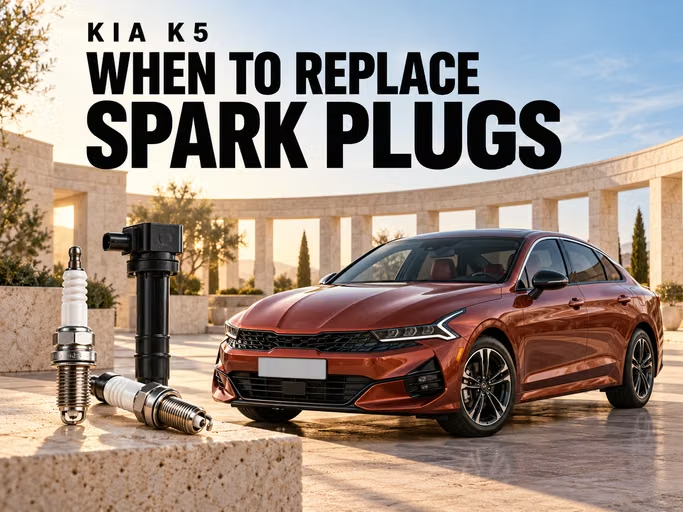
The Kia K5 spark plug replacement interval depends on the engine, model year and operating conditions. The model name and displacement alone are not enough: a naturally aspirated K5 2.5 and a turbocharged K5 GT require separate checks of the schedule and parts specification.
This article focuses on the petrol DL3-generation K5, covering scheduled replacement, fault symptoms and plug selection. Glow plugs are discussed separately for older diesel vehicles in the K5/Optima family; that system does not apply to the petrol DL3.
Before servicing the car, match its VIN and engine designation to the correct manual. For an imported vehicle, establish its original specification instead of relying solely on the description in a sales listing.
Which plugs does your K5 use
The engine specifications in the 2023 K5 DL3 manual list the petrol 2.0 MPI and Smartstream G2.5 GDi. Both are four-cylinder engines using spark plugs, normally supplied as a set of four for a complete replacement.
| Vehicle version | Plug type | Selection basis |
|---|---|---|
| DL3 2.0 MPI and 2.5 GDi | Spark plugs | VIN and engine code |
| Turbocharged K5 | Spark plugs | Turbo engine documentation |
| Petrol K5 hybrid | Spark plugs | Hybrid-specific manual |
| Older diesel K5/Optima | Glow plugs | Exact CRDi application |
Why trim names cannot replace the engine code
GT and GT-Line badges do not provide a universal answer about the engine, while the 2.5 designation does not establish whether it is turbocharged. Supply the year, VIN and engine type when ordering. A body photograph or a visually similar plug cannot confirm compatibility.
Does a hybrid need spark plugs
A hybrid with a petrol engine still uses a spark to ignite the mixture. Electric driving does not eliminate spark plug maintenance. Follow the hybrid manual rather than deducting electric-only kilometres from the odometer reading yourself.
If the car has an uncertain service history, look for evidence of the last replacement. A generic service stamp without an itemised invoice or plug part number does not establish that a new set was fitted.
Spark plug replacement intervals
The 2023 K5 DL3 maintenance schedule on ownersmanual.kia.com gives the following guidance for the petrol engines covered by that edition.
| Application | Normal use | Check before applying |
|---|---|---|
| 2.0 MPI and Smartstream G2.5 GDi using unleaded petrol | Every 150,000 km | The manual matches the car |
| Turbo models, hybrids and other years | Use their own manual | Do not copy the first interval |
| Severe use for the covered versions | Replace more frequently | Agree the timing with the workshop |
The spark plug row does not give a separate interval in months. Follow any additional requirements in the vehicle’s service booklet. Record the mileage, date and fitted part number on the invoice.
Short journeys and heavy traffic
The severe-use plug schedule covers conditions including repeated short journeys, heavy traffic and frequent stop-and-go driving. It does not specify a single reduced mileage. Advice to replace every 30,000 km or automatically halve the normal interval cannot substitute for the correct schedule.
Technical guidance on ngkntk.com explains how short trips and continuous low-speed driving can contribute to plug fouling. When poor engine operation is the cause, fitting new plugs alone may provide only temporary relief.
For a car used in the UAE, describe the actual driving pattern to the workshop, including journey length, daily congestion and commercial use. Hot weather alone does not provide a numerical formula for plug life.
Glow plugs on older diesel versions
The petrol K5 DL3 does not use glow plugs. This section concerns older diesel vehicles in the K5/Optima family that may appear among imported cars. Their equipment should not be attributed to the modern petrol sedan.
Kia’s official Optima technical document describes a 1.7 CRDi engine. This is an example of an older diesel application where glow plug servicing is relevant. Confirm the engine through the VIN before selecting parts.
What glow plugs do
A diesel engine ignites fuel through the heat of compressed air. Glow plugs help warm the combustion area for starting; depending on the control system, heating also continues after the engine starts. They do not produce a spark and cannot be exchanged with petrol spark plugs.
When to investigate a fault
The fault-finding article on denso-am.eu identifies difficult starting, uneven running after starting and smoke as reasons to investigate. Faulty glow control or electrical supply can damage replacement plugs, so the whole system needs checking.
A weak battery, insufficient cranking speed, injector problems and compression also affect starting. Replacing plugs without investigating those causes may not resolve the complaint. Petrol plug intervals do not apply to CRDi engines; check the maintenance requirements for the exact diesel vehicle.
Why removal requires care
Do not force a seized glow plug out with an arbitrary amount of torque: the body or tip can break. The workshop must follow the removal procedure and torque limits. A replacement must match the specified voltage and control system as well as its physical dimensions.
Checking and replacing spark plugs
Difficult starting, hesitation under load and an uneven idle warrant diagnosis. These symptoms do not prove a plug failure: the workshop should also consider ignition coils, fuel delivery and the mechanical condition of the engine.
What a misfire code means
A code such as P0301 identifies detected misfiring in cylinder one, not a particular failed component. Diagnose the cause before buying a set of coils. If the engine shakes severely and the Check Engine light flashes, reduce load and stop safely to avoid worsening catalytic converter damage.
The K5 maintenance explanations specify the correct plug heat range and clean plug insulators and coil boots during assembly. Matching the thread alone is not enough to select an alternative part.
Replacement checklist
☐ Confirm the VIN, engine, part number and number of plugs.
☐ Check the specified gap and tightening torque for the selected part.
☐ Switch off the ignition and let the petrol engine cool.
☐ Clean the wells and inspect the coils, boots and connectors.
☐ Investigate the source of any oil found in the plug wells.
☐ Check engine operation afterwards and record the replacement mileage.
The installation guidance on ngksparkplugs.com explains the importance of correct tightening. There is no universal torque for every K5 plug: verify it against the repair information and the plug manufacturer’s instructions.


