


Hyundai Tucson: when to replace the cabin air filter
Hyundai Tucson
Hyundai Tucson•
•21 views
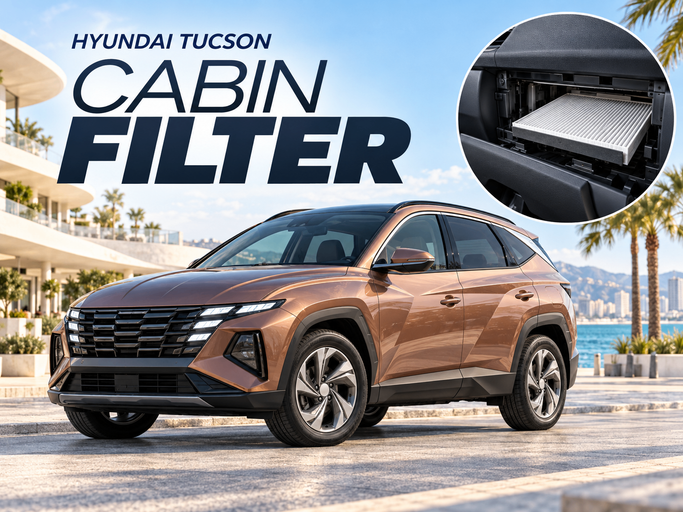
Check the Hyundai Tucson cabin air filter if your usual fan setting no longer delivers a comfortable flow of air. However, warm air from the vents and a musty smell can have other causes. Here is how to plan servicing, choose a filter for your particular Tucson and assess the result after replacement.
How to plan replacement
Start with your Tucson’s service schedule
The Tucson NX4 maintenance section on ownersmanual.hyundai.com says to replace the cabin air filter according to the maintenance schedule. Dusty roads call for more frequent inspections and replacement. This advice does not establish a single interval for every Hyundai Tucson.
Find the Cabin air filter or Climate control air filter entry in the service documentation. Check that the table applies to your vehicle’s production year and market. Where both distance and time are specified, follow the rule stated in that table. Count from the last documented replacement, rather than the date you bought the car.
When an earlier inspection makes sense
If the car regularly travels near construction sites, uses unpaved access roads or has recently been driven through dust, discuss the filter’s condition separately at a service visit. Low mileage alone does not establish that it is clean. Ask to see the removed element and have any contamination, damage or moisture recorded.
When the service history is unknown, first establish the condition and suitability of the fitted part. After any necessary replacement, keep the date, mileage and part number. This provides a useful starting point for future servicing. A general entry reading “air conditioning checked” does not confirm that the cabin filter was replaced.
Which symptoms point to the filter?
Compare airflow while parked, using the same fan speed, vent direction and recirculation setting. Open the vents and temporarily select a manual fan speed: automatic climate control can change airflow by itself. Record whether the complaint developed gradually or appeared immediately after servicing.
| Observation | First check | Next step |
|---|---|---|
| Airflow has weakened | Fan settings and whether the vents are open | Inspect the filter; investigate ventilation if needed |
| Strong airflow, warm air | A/C selection and the temperature setting | Diagnose cabin cooling performance |
| Whistling after replacement | Filter seating and cover fastening | Correct the installation and check again |
Choosing a filter for the Hyundai Tucson
Match the generation, VIN and part number
A part labelled “for Tucson” is not confirmed suitable until its catalogue application has been checked. Generations and specifications can differ. Before ordering, give the supplier the VIN and production year, and ask for confirmation of the part number and its suitability for your individual car.
The old filter is useful for comparison, but it should not be the only reference: a previous owner may have selected the wrong part. Compare length, width, thickness and frame shape. Do not trim a new element or force it into place with the cover. The engine air filter is a separate component and does not filter air supplied to the passenger compartment.
Particle or activated-carbon filter?
The material guide on mann-filter.com explains that a particle filter captures airborne particles, while an activated-carbon layer also captures some gaseous pollutants and odours. Choose this option only after confirming compatibility. A carbon layer does not remove a source of dampness inside the climate-control system.
| Type | Purpose | What to check |
|---|---|---|
| Particle filter | Filtering airborne particles | Correct application, intact pleats and frame |
| Activated-carbon filter | Particles plus some gases and odours | New filter media may naturally be dark |
| Additional functional layers | Specific advertised functions | Properties of the individual product |
Do not judge remaining service life by colour alone: new activated-carbon media can already be dark. Inspect the pleats, frame and accumulated debris, then consider the replacement history. A wet, torn or distorted element calls for investigation of the cause, rather than an assessment based only on how clean it looks.
When booking the work, ask for the part number to be included on the service invoice. Keep the packaging or a photograph of the identification after installation. At the next service this will help confirm compatibility and identify the type fitted, without relying on a vague entry such as “filters replaced”.
Replacement and checking the result
On the Tucson NX4 described in the manual, the filter is behind the glovebox. Confirm the release procedure for the stops and fasteners on your vehicle. Turn off the ventilation and ignition and empty the glovebox before starting. If access does not open freely, check the fasteners instead of forcing the plastic.
Remove the old element carefully, keeping loose debris on it. Clear accessible dirt from the housing without pushing it farther into the system. The new filter should sit squarely in its intended position. If the cover does not latch, check the size and orientation before reassembling the glovebox.
The explanation on fram.com distinguishes AIR FLOW from UP markings: the first shows air direction, while the second identifies the top of the element. Do not rely solely on the old filter’s orientation. Check the instructions for the replacement and the vehicle. A photograph of the previous installation is useful, but does not prove it was correct.
After reassembly, check several fan speeds and return to the settings used for the comparison before replacement. Make sure there is no new whistling, the cover is secure and the glovebox works normally. Tell the workshop if the original complaint remains: another speculative filter change is not a substitute for diagnosis.
Persistent odour needs separate attention. An article on denso-am.eu links some unpleasant smells to contamination on damp internal climate-control surfaces. A new filter does not clean the evaporator. Note when the smell occurs: when ventilation starts, after using air conditioning, or continuously.
Post-service checklist
☐ Compatibility confirmed and part number recorded.
☐ Installation direction checked and cover secured.
☐ Airflow compared using the same settings.
☐ Replacement date, mileage and outcome recorded.
If you are choosing a car, browse current offers for the Hyundai Tucson on AUTO.AE. Check the ventilation and ask for service records when viewing a vehicle: a clean interior does not reveal the condition of the hidden filter.
Conclusion
For the Hyundai Tucson, use the schedule for the individual version and account for operating conditions. Correct selection, careful installation and an airflow check matter more than a claimed universal interval. If airflow or odour does not improve after replacement, continue investigating the climate-control system.


