When to change Ford Ranger transfer case oil
Ford Ranger
Ford Ranger•
•13 views
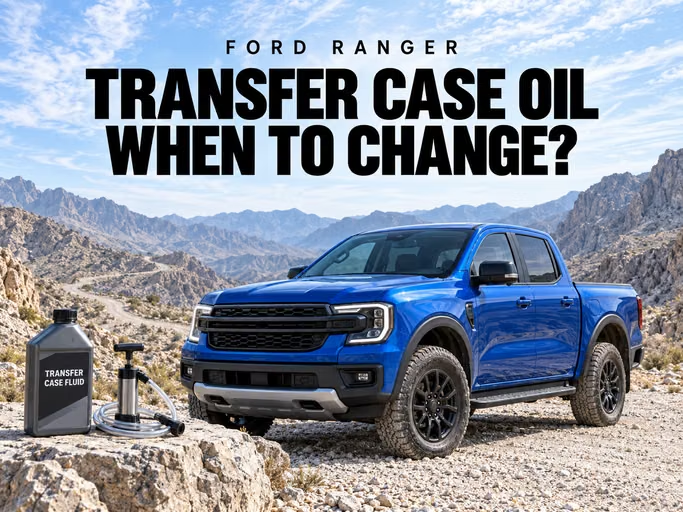
The cover is illustrative. The bottle and hand pump do not identify a specific product or a mandatory replacement method. Confirm the fluid, capacity and service procedure for the installed transfer case.
On a four-wheel-drive Ford Ranger, transfer case fluid is serviced separately from the main gearbox fluid and axle lubricants. The replacement decision depends on the vehicle configuration, applicable schedule and workload. A pickup that mainly carries tools on paved roads and one used regularly on soft sand may need different maintenance decisions even when their odometer readings are similar.
For an owner in the UAE, identifying the four-wheel-drive system is more useful than searching for one universal mileage. Rangers include selectable four-wheel-drive systems and versions with an automatic 4A mode. Their transfer case capacities can differ too. This guide explains how to distinguish those configurations, choose fluid and recognise when a scheduled service is appropriate or a fault needs investigating first.
Which transfer case does your Ranger have
A factory 4×2 Ranger has no transfer case routing drive to the front axle. On a 4×4 version, the assembly remains part of the drivetrain when 2H is selected. Saying that you only drive the rear wheels therefore does not establish whether the vehicle has a transfer case. The factory configuration and the currently selected driving mode are different things.
A part-time system engages the front axle through 4H or 4L. Advanced 4×4 adds 4A. According to the Ranger manual’s explanation of four-wheel-drive operation, this mode automatically varies power delivery to the front wheels to suit conditions. Low range, or 4L, serves a separate purpose by providing additional gear reduction for demanding driving situations.
Confirm the assembly type using the VIN and applicable documentation. If the transfer case has been replaced, check the identity of the unit actually installed as well. Engine size, registration year and exterior badges do not provide complete identification. This matters across Ranger generations and Raptor variants: a similar-looking pickup is not sufficient evidence for copying a fluid capacity or workshop procedure.
The work order should distinguish the transfer case, main transmission, front axle and rear axle. They do not share one common fluid volume. An automatic gearbox fluid change does not renew the transfer case lubricant, and a rear axle service does not establish that the transfer case received attention. Precise records prevent misunderstandings at the next service or when the vehicle is sold.
How to establish the replacement interval
The 2024 Ranger maintenance table lists transfer case fluid changes at 48,000 km for severe service and 240,000 km in the general table. However, the exceptions section on that page says routine maintenance is unnecessary and addresses severe use, leakage and immersion separately. Because those statements differ, confirm the applicable interval with an authorised workshop using the documentation for your specific vehicle.
Those figures should not be treated as a universal Ranger schedule. Another model year, drivetrain or regional service programme may have different requirements. Ask the workshop to identify the basis for its recommendation: a specific scheduled item, preventive advice or a diagnostic finding. A statement that all pickups receive the same service interval does not provide that evidence.
When the service history is unknown, start with inspection and any records that can be recovered. If no previous fluid change can be confirmed, discuss a baseline service after identifying the assembly and required product. Unknown fluid mileage warrants assessment, but does not prove that the transfer case is faulty. Conversely, a short distance since the last service does not make a fresh leak harmless.
| Operating situation | What the maintenance plan should address |
|---|---|
| Paved roads, routine journeys and no complaints | The applicable schedule and previous records specifically identifying transfer case work. |
| Frequent sand driving, towing or heavy loads | Whether severe-service requirements apply and the agreed interval. |
| Used Ranger with an uncertain history | Inspection, fluid assessment where indicated and the basis for an initial change. |
| Assembly submerged in water | Possible contamination and the condition of seals and ventilation. |
| Noise, shudder or a 4×4 warning | Diagnosis before promising that a fluid change will resolve the symptom. |
What to tell the workshop about the workload
For a working pickup, the load matters as well as the route. Explain whether your Ranger regularly carries equipment, tows a trailer or climbs steep tracks at low speed. For a leisure vehicle, describe the duration of sand driving, repeated wheelspin and any instrument-panel messages. A short access track to a campsite and an extended dune trip are different operating scenarios.
Record unusual events such as stopping because of a warning, an underbody impact, drivetrain immersion or new fluid traces after a trip. This helps relate a complaint to actual conditions instead of attributing everything to hot weather. Dust on the outside of the housing does not by itself establish internal contamination. An inspection needs to identify any route for water entry or the source of a leak.
If preventive work is agreed before a long journey, leave time for a follow-up check. A leak discovered after servicing or a persistent noise can then be assessed before departure. Ask for the inspection outcome as well as a list of replaced fluids. That information matters when deciding whether the vehicle is ready to resume its usual towing or off-road workload.
Which fluid to use and how much is required
For the configurations below, the 2025 Ranger owner’s manual specifies Motorcraft MERCON LV meeting WSS-M2C938-A. These figures apply to the assemblies described in that manual and do not replace identification of your vehicle. The distinction between part-time and automatic four-wheel drive matters even when the specified fluid is the same.
| Configuration in the 2025 Ranger manual | Required fluid | Listed capacity |
|---|---|---|
| Electronic Shift-on-the-Fly, selectable 4×4 | MERCON LV / WSS-M2C938-A | 1.2 litres |
| Automatic four-wheel drive, Raptor | MERCON LV / WSS-M2C938-A | 1.55 litres |
The listed capacity helps prepare the necessary supplies. The actual refill must finish with the level set according to the procedure for that transfer case. Do not automatically use the larger figure from the next row or guess an allowance for fluid remaining inside. Vehicle position, draining method and level-check conditions should follow the applicable service information.
An ATF label does not establish universal compatibility. For example, the 2018 Ranger specifications list MERCON LV for the transfer case and ULV ATF with a different specification for certain automatic transmission applications. Read the entry matching the correct assembly and engine. MERCON LV, MERCON ULV and MERCON V should not be treated as alternative names for the same fluid.
Five signs that require investigation
1. Fresh wet areas on the housing or drops after parking
Establish where the fluid is escaping. It may run down from an adjacent assembly, so a stain beneath the vehicle is not enough to identify the source. After cleaning, the technician should inspect the housing, connections and seals. If the level is falling, topping up does not replace fixing the cause. Ask to see the leak location and have any repair recorded separately.
2. A new hum or vibration during acceleration
Note the speed, selected mode and relationship to load. Tyres, driveshafts, bearings and axle assemblies can produce similar sensations. Changing transfer case fluid before locating the source may make no difference. A description such as “vibration under acceleration with a loaded bed” is more useful to the technician than an unverified assumption about which component has failed.
3. Shuddering or resistance when turning on pavement
Check the selected mode first. The Ranger four-wheel-drive limitations state that 4H and 4L should not be used on dry, hard surfaces because noise, tyre wear and drivetrain damage can result. Fresh fluid cannot correct the use of an inappropriate mode. If the symptom remains during correct operation, the drivetrain and tyre set need assessment.
4. Four-wheel drive will not engage or disengage
Not every message means a component has failed. The four-wheel-drive message explanations distinguish shift instructions, temperature protection and faults. Check 4x4 calls for system assessment, whereas a request to select neutral may concern the conditions needed to complete a shift. Save the exact message and avoid clearing diagnostic information before the vehicle is examined.
5. Water or unusual particles in drained fluid
An emulsion, conspicuous metal particles or a strong overheating smell requires assessment of the assembly. Dark colour alone cannot show how much fluid life remains, while normal appearance does not rule out other problems. Ask for the finding to be recorded and for an explanation of whether servicing is sufficient. If water entry caused contamination, its cause must also be addressed.
Why tyres and drive modes should be checked first
Tell the technician if the complaint began after a wheel change. Mismatched tyre sizes can affect four-wheel-drive operation, as explained in the Ranger manual. Check the permitted size, pressures and any substantial difference in wear. The wheels are part of a sensible drivetrain diagnosis even when the owner initially asks only for an oil change.
Do not try to prove that the transfer case works by making repeated tight turns in 4H on a dry parking area. Mode changes and checks must take place under the conditions allowed by the manual for your version. If the indicator has not confirmed completion of a shift, do not assume it has finished solely from the selector position. Recurring difficulty needs investigation rather than forceful attempts to make the system change modes.
What low level or incorrect fluid can lead to
Insufficient lubrication and contamination can reduce protection of moving surfaces. An unsuitable fluid may also change the operating conditions the assembly was designed for. If mechanical components are already damaged, a refill will not restore them. The outcome of routine maintenance and the outcome of repair should therefore be assessed separately: eliminating a noise cannot be promised before its cause is established.
Overfilling is not an extra reserve of reliability. Correct level and a leak check are required after servicing. If there is substantial fluid loss, loud impacts, smoke or loss of drive, stop safely and arrange assistance. Recovery must follow the vehicle’s requirements. Selecting neutral in the main gearbox alone does not establish that towing with wheels on the road is permitted.
How to review the completed service
Before starting, the technician should confirm the assembly, chosen product and work procedure. Access to the filler opening should be checked before draining, and dirt around the plugs removed. Underbody protection removal, plug sealing and tightening must follow the relevant procedure. There is no universal plug torque for every Ranger in this guide: the value must be established for the actual unit.
During draining, assess the fluid and accessible inspection points. Significant findings should be discussed with the owner before closing the job. If flushing is proposed, ask how it will be done and why: a familiar operation on another gearbox is not automatically required for the transfer case. Clean filling equipment should prevent residues of incompatible products entering the assembly.
After filling, verify the level and absence of leakage. Where there was an original complaint, check the behaviour again under safe conditions. The invoice should record the fluid specification, product, quantity used, odometer reading and completed operations. A remaining symptom needs an agreed diagnostic next step. “All oils replaced” is too broad a record to guide future maintenance.
Six common mistakes
- Confusing a factory 4×2 configuration with 2H mode on a four-wheel-drive Ranger.
- Copying the schedule and capacity from another generation or Raptor variant.
- Treating an automatic transmission or rear axle service as a transfer case fluid change.
- Choosing fluid by colour or mixing different MERCON specifications.
- Trying to cure shudder with fluid before checking drive mode and tyres.
- Ignoring leakage, immersion or a recurring four-wheel-drive warning.
Ranger owner checklist
☐ Confirm the VIN, model year and factory drive configuration.
☐ Identify the installed transfer case and whether 4A is available.
☐ Find the applicable schedule and the reason for the fluid change.
☐ Describe loads, towing, sand use and any immersion in water.
☐ Record symptoms and dashboard messages before faults are cleared.
☐ Verify the fluid specification and level-setting procedure.
☐ Check tyre suitability and correct drive-mode selection.
☐ Obtain the result of the post-service leak inspection.
☐ Keep the invoice and agreed date or mileage for the next assessment.
Conclusion
Ford Ranger transfer case maintenance begins with correct drivetrain identification. A part-time system and one with 4A need their own requirements checked, while the schedule must match the vehicle and workload. Investigate leakage, noise or difficult shifts before choosing a remedy. The correct fluid maintains a serviceable assembly; it does not substitute for repairs.
When choosing a used pickup, compare current offers and request drivetrain records. A documented transfer case history, underbody inspection and correct mode checks provide more useful evidence than a seller’s assurance that four-wheel drive was hardly ever used.