When should you replace the Ford Ranger oil filter in the UAE?
Ford Ranger
Ford Ranger•
•6 views
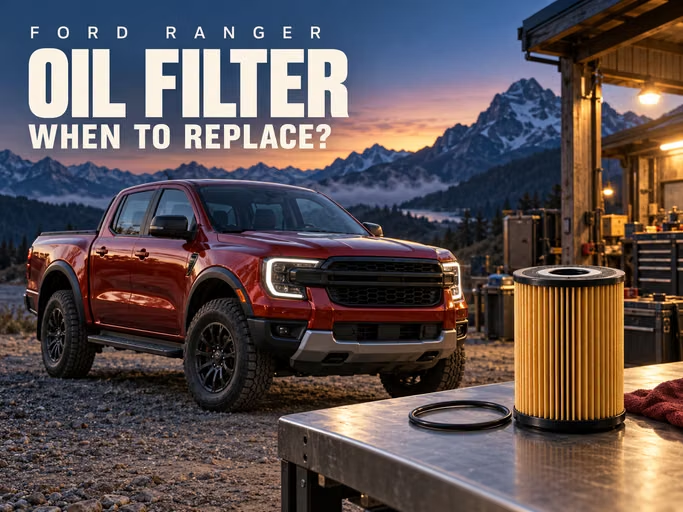
Artistic illustration: the vehicle and filter are shown for visual reference. Check the actual component design and fitment against the VIN, engine and model year.
Replace the Ford Ranger oil filter together with the engine oil at scheduled oil services. The timing, however, cannot be selected from the pickup's name alone. Diesel Rangers, petrol EcoBoost versions and earlier generations need the correct parts and maintenance schedule for their engines. Carrying loads, waiting on site with the engine running and driving on sand also matter when planning the next visit.
For an owner, the process has three parts: identify the exact vehicle, establish when its service is due, and check the result afterwards. A fresh windscreen sticker or a clean filter housing does not, by itself, prove that the job was completed correctly. The following guide explains which records to check and which questions to ask a workshop to avoid unnecessary costs and mistakes.
Establish the replacement interval for your Ranger
Start with the last service invoice. Look for the date, odometer reading, filter part number and details of the oil used. If the description says only “oil change”, establish whether the filter was replaced. Then find the maintenance schedule for the model year and installed engine, taking operating conditions into account. Save the relevant page with your service records so that future recommendations can be compared against the same requirements.
The hot-climate exception in the 2025 Ranger owner's manual specifies 4,800 km for the Middle East under its stated API SM/SN petrol-engine oil conditions. This is a provision in a particular document, not a universal interval for every Ranger. Do not transfer it to a diesel without checking applicability; the oil must still meet the requirements of the actual engine.
Why do online recommendations give different distances?
The Ranger name covers different generations, engines and service programmes. A number in a search result may concern a different vehicle or operating pattern. Even an accurately copied figure becomes unsuitable advice when its conditions are omitted. Ask the workshop, “Which schedule applies to my VIN?” rather than simply asking how often Ranger owners usually return for servicing.
A general maintenance page is a useful starting point, but it does not replace the vehicle-specific plan. For example, the guidance on me.ford.com includes a six-month calendar reference and more frequent servicing for demanding use. Agree both a mileage limit and a date for your Ranger. Covering little distance between journeys does not remove a calendar requirement.
Can you rely on the remaining oil-life display?
If the vehicle has an Intelligent Oil-Life Monitor, its calculation helps plan servicing around use. It estimates oil life; it does not directly measure how contaminated the filter is. Knowing when the system was reset, and what work preceded the reset, is essential. If a previous owner cleared the reminder without replacing anything, the display cannot reconstruct the missing maintenance history.
A short phone note is useful: “oil and filter replaced”, followed by the date, odometer reading, next due date and mileage limit. Record engine hours as well if that information is available, especially for a working pickup. Avoid converting hours into kilometres using an arbitrary internet formula. Any conversion used to determine servicing should have a basis in the applicable maintenance instructions.
Choosing a filter for diesel and petrol Rangers
The regional Ranger engine comparison lists 2.0-litre Single-Turbo and Bi-Turbo diesels, the petrol 2.3 EcoBoost, and a 3.0 V6 EcoBoost for the Raptor. This illustrates the variety within the range; it is not a parts catalogue. A trim name and a photograph of the pickup are insufficient information for ordering an oil filter.
Give the supplier the VIN, model year and precise engine details. Mention any replacement engine or changed filter housing separately: the factory build record may no longer describe the installed assembly. An old filter box can provide an additional clue, but its part number should also be checked rather than treated as automatically correct.
| Version or situation | Information to confirm | Why it matters |
|---|---|---|
| 2.0 Single-Turbo or Bi-Turbo | Engine code, year and VIN-based catalogue entry | Equal displacement does not prove interchangeability |
| 2.3 EcoBoost | Exact variant and build date | A diesel Ranger is not a fitment reference |
| Raptor 3.0 EcoBoost V6 | Engine and kit compatibility | The Raptor name alone does not identify every generation |
| Earlier vehicle or replacement engine | Equipment actually installed | Appearance and registration year can be misleading |
A cartridge element or a complete spin-on filter?
The design overview on mann-filter.com shows replaceable filter elements and complete spin-on filters. These are different component designs. Buy the version specified for the engine, rather than the one that resembles an article illustration. A picture of an exposed pleated cartridge does not mean that every Ranger uses that particular type of filter.
With a cartridge, the element must seat correctly and the housing needs its specified seals; with a spin-on filter, the complete assembly must be suitable. Matching external dimensions alone does not establish compatibility. Ask for the actual part number and confirmed application to appear on the order. If a supplier offers a superseding number, the workshop should be able to explain how that replacement was verified.
Must the replacement be a genuine Ford filter?
Base the decision on verified compatibility, the vehicle's requirements and any applicable service terms. A familiar brand on a box cannot correct a fitment error. An alternative needs an exact catalogue reference, suitability for the engine and a traceable source. A claim that it “fits most Fords” is not sufficient justification for fitting it.
Before installation, inspect the packaging and component for damage, signs of use, deformation or inconsistent markings. Confirm which seals are supplied. Do not assume that paying more automatically authorises a longer interval, or that new oil allows an old filter to remain for another service cycle. The maintenance requirements determine the interval; the purchase price does not.
How loads, idling and sand affect service planning
Two Rangers showing the same mileage can have very different working lives. One may travel mainly on highways without a load. Another may move between worksites and spend considerable time stationary with its engine running. The odometer does not show all engine operating time. When booking a service, describe a normal working day rather than providing only an average monthly distance.
A trailer, a regular payload, low-speed work and frequent dusty routes are reasons to discuss whether severe-use provisions apply. Distinguish an occasional outing from a sustained operating pattern. An arbitrary rule to replace everything after any unpaved road is not a useful plan. Neither is treating every journey as normal service simply because the vehicle did not overheat.
| Ranger use | Information to record | What to agree with the workshop |
|---|---|---|
| Waiting on site with the engine running | Approximate duration and frequency | How to account for operation without added mileage |
| Regular towing | Frequency, load and route characteristics | The applicable maintenance category |
| Sand and unpaved routes | Duration and regularity | Oil and filter timing and necessary inspections |
| Infrequent short journeys | The previous service date | The next calendar deadline |
Should you replace the filter after every desert trip?
There is no automatic answer for the entire model range. If the trip falls within the operating pattern already covered by your service plan, use that plan and the inspection findings. If the workload changes substantially, discuss it before the next demanding outing. Underbody damage, a fresh leak or a dashboard warning requires a separate assessment regardless of the remaining scheduled interval.
Sand on the bodywork does not measure contamination inside the oil filter. External dust, the engine air filter and the lubrication system are different inspection subjects, even though the journey may affect all of them. A statement that the pickup is very dirty should not substitute for an assessment. Ask which service is needed and what evidence or schedule supports it.
Planning a journey with a trailer
Count the entire trip, including the return leg and travel at the destination. For example, if only 700 km remains before the agreed service mileage and the planned journey is approximately 1,100 km, arrange the servicing decision beforehand. This is a planning example, not a new Ranger maintenance interval. Leave time after the work to check the oil level and confirm that no leaks appear.
Separately establish whether the permitted towing load suits the vehicle and its equipment. A fresh filter does not raise the allowed trailer weight or compensate for overloading. When choosing a used pickup from current offers, request consistent service records and information about its previous work. A recent pre-sale oil change is only one entry in that history.
What to check during and after replacement
Before work starts, agree the contents of the quotation: the filter, suitable oil, required seals and any work needed to access the assembly. Compare offers covering the same operations. A low package price means little if one quote includes consumables and leak checks while another covers only the technician's labour.
Avoid applying one universal replacement procedure to all Rangers. The component's location, housing design, access through protective panels and installation sequence depend on the engine. In particular, a cartridge-housing cap torque must not be transferred to a spin-on filter. Establish that the technician is using instructions for the equipment actually installed.
The FILTRON instructions for spin-on filters specifically call for checking that the old gasket has been removed from the mounting surface. A cartridge assembly needs its own seal-installation procedure. Tightening a leaking assembly harder without finding the cause is not a substitute for correct installation.
| Stage | Check required | Information to retain |
|---|---|---|
| Selection | Engine and filter compatibility | Installed filter part number |
| Installation | Seals, mounting condition and tightening | Work completed and additional parts |
| Filling | Oil specification and final level | Oil product, specification and quantity |
| Completion | Leak checks and correct reminder reset | Date, mileage and next service deadline |
Can you replace only the filter or just top up the oil?
At a scheduled oil service, replace the oil and filter together. Topping up corrects the level but does not renew the filter element. A separate filter replacement may be necessary during a repair; record it as a separate operation and establish when the oil is next due. Repairing a fault and completing a scheduled service are not necessarily the same job.
If oil consumption increases or repeated top-ups become necessary, keep a record of quantities and mileage. That symptom alone does not identify the filter as the cause: diagnosis is needed. A new component is not a universal cure for leakage, a changing oil level or unusual noise. The workshop will benefit from knowing when the symptom appears and whether it began after the last service.
Collection checklist
☐ The invoice records the date, mileage, filter part number and oil details.
☐ The level has been checked using the engine-specific procedure.
☐ The filter and drain-plug areas have been cleaned and checked for leaks.
☐ Protective panels and removed fasteners have been refitted.
☐ The reminder was reset after the work and the next deadline was agreed.
After servicing, look for fresh oil beneath the vehicle and in safely accessible inspection areas. Residual spilled oil and an ongoing leak need different responses, so a clean surface and a repeat check are useful. If a mark returns, report it to the workshop instead of trying to conceal the issue with another wash or top-up.
An oil-pressure warning with the engine running means you should stop safely and switch off the engine. It is not an ordinary filter-service reminder. A normal oil level does not rule out a lubrication-system fault; follow the manual and arrange diagnosis before deciding whether to continue. A substantial leak or new severe mechanical noise also needs attention rather than waiting for the next scheduled service.
Conclusion
A reliable Ford Ranger oil-filter plan starts with the exact engine and the correct maintenance schedule. Replace the filter with the oil, account for calendar limits and the pickup's actual work, and retain part numbers and service records. Before a demanding journey, check the remaining interval against the whole route. Afterwards, check the level, sealing and paperwork. That approach is more useful than assigning one distance to every diesel, petrol and earlier Ranger.