When should you replace spark plugs and glow plugs in a Ford Ranger?
Ford Ranger
Ford Ranger•
•5 views
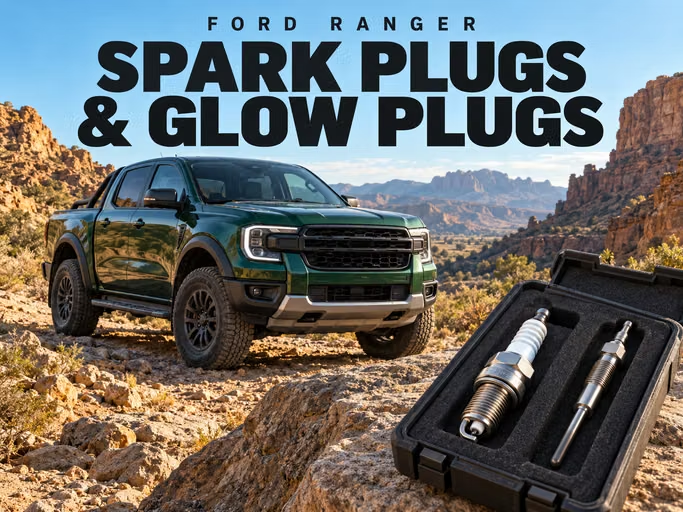
The cover shows examples of a spark plug and a glow plug for different engine types. It illustrates the topic; component shape and scale do not replace a fitment check for the particular Ranger.
There is no single Ford Ranger maintenance interval for every type of plug. Petrol engines use spark plugs; diesels use glow plugs. Spark plugs follow the applicable replacement schedule and may need earlier attention after a confirmed fault. Glow plug decisions require the diesel version's service requirements and an assessment of its glow system.
Before ordering parts, establish the model year, engine and service history. Ranger, Wildtrak or Raptor badges are not enough. Carrying loads, towing, extended idling and driving on sand all provide useful context when choosing a schedule or investigating a complaint.
This guide separates routine replacement from fault diagnosis, explains the signs worth checking and identifies what to agree with the workshop so that new parts address the actual problem.
Which plugs does your Ranger use?
The model page at me.ford.com lists 2.3 EcoBoost and 3.0 V6 EcoBoost petrol engines alongside single-turbo and bi-turbo 2.0 diesels. Earlier vehicles can have other engines: for example, an earlier-generation owner's manual covers 2.2 and 3.2 Duratorq-TDCi diesels and the 2.5 Duratec-HE petrol engine.
That difference determines the component type. A spark plug produces an ignition spark. A glow plug heats electrically to help a diesel establish suitable combustion conditions. They are not interchangeable, nor are they two sets that must both be fitted to the same engine.
| Engine version | Required plug type | What to verify |
|---|---|---|
| 2.3 EcoBoost petrol | Spark plugs | Year, engine code and part number |
| 3.0 V6 EcoBoost petrol | Spark plugs | Exact version and calibration |
| 2.0 Turbo / Bi-Turbo diesel | Glow plugs | Engine code and electrical specification |
| 2.2 / 3.2 TDCi diesel | Glow plugs | Generation and fitment |
| 2.5 Duratec-HE petrol | Spark plugs | Documentation for its model year |
This table establishes the type of component, not a catalogue match. Check the vehicle identification number, or VIN. First registration and model year can differ. If the engine has been replaced or modified, compare the original vehicle data with the configuration actually installed.
Why a trim badge is not enough
Badges and exterior equipment do not establish the engine type. Even a familiar Raptor name is not a reason to transfer plug specifications or maintenance intervals from another generation. Confirm fuel type, engine and year before selecting parts.
When comparing current offers, consider what the service records actually contain. A note saying “plugs replaced” without a part number or mileage provides little useful evidence. Ask which components were changed, why the work was needed and whether the original complaint disappeared.
Spark plug replacement mileage
The 2024 Ranger owner's manual lists replacement at 100,000 miles, or 160,000 km, with a severe-service entry at 60,000 miles, or 96,000 km. This is an example from a specific document for petrol versions, not an interval covering every Ranger.
For your vehicle, verify the appropriate schedule, engine coverage, conditions for the shorter interval and accompanying notes. If a workshop proposes a different frequency, ask for its basis. A figure copied from another vehicle's invoice is not a substitute for the applicable maintenance requirements.
Describe how the pickup works
- Explain how often it carries a load or tows a trailer.
- Mention sustained sand driving or other high-load operation.
- Describe time spent stationary with the engine running.
- Explain whether short journeys or longer trips predominate.
- Report misfires, warnings and changes since the previous service.
A working Ranger with low mileage is not necessarily having an easy life. Waiting with the engine running adds little distance to the odometer. Equally, an arbitrary conversion of engine hours into kilometres should not determine the plug interval. Operating hours provide context rather than a separate invented service schedule.
If the previous replacement is unknown
Try to reconstruct the history from invoices and workshop records. Without evidence, discuss inspection and possible replacement to establish a documented starting point. If the engine already runs unevenly, diagnosis comes first: new plugs will not repair an injector, coil or mechanical fault.
Ask for the installation mileage and part numbers to be recorded. Those details make the next service decision easier than relying on an old box or the previous owner's recollection. Reliable starting alone does not establish how much useful life remains in the plugs.
A petrol Ranger hesitates or loses power
New hesitation, rough idle, difficult starting and an engine warning lamp warrant investigation. A worn or damaged spark plug can contribute, but coils, wiring, injectors and other systems can produce similar symptoms.
Tell the workshop exactly when the complaint occurs: accelerating without a load, towing, after an overnight stop or with the engine warm. Mention recent refuelling, engine-bay cleaning and repairs. Do not try to reproduce a dangerous fault through hard acceleration.
A cylinder fault does not identify the failed part
A misfire code helps direct the investigation; it is not a ready-made shopping list. Preserve the codes and recorded conditions, then check ignition, fuel delivery and other possible causes.
HELLA's technical diagnosis guidance notes that ignition test findings can be affected by engine mechanics, including compression. Replacing another plug in the same cylinder without identifying why the fault returned is therefore an incomplete approach.
| Driver's observation | Useful information | Next step |
|---|---|---|
| Hesitation under load | Cargo, trailer and temperature | Diagnose under comparable conditions |
| Uneven first start | How long the vehicle stood | Check starting and recorded data |
| Fault after servicing | Work performed and part numbers | Inspect assembly and original cause |
| Recurring cylinder fault | Earlier repair findings | Investigate the underlying causes |
Must the coils be changed as well?
A complete set of coils is not automatically required whenever spark plugs are replaced. The decision should follow inspection and testing. Conversely, new plugs cannot restore a damaged coil, boot or connector. Ask which findings support each additional replacement.
If the complaint appeared immediately after work, provide the invoice rather than assuming the new parts have simply worn out. The workshop needs to check what changed and whether the earlier fault was fully resolved. That comparison can prevent another round of unnecessary purchases.
When to check diesel glow plugs
Difficult starting after a stop, rough running immediately after starting, unusual smoke and fault messages warrant investigation. None of these symptoms alone proves a failed glow plug: battery, starter, electrical supply and injection problems can produce a similar complaint.
Describe whether the engine had genuinely cooled down or was being restarted hot, how starting time has changed, whether a warning appears and how long uneven running lasts. A diesel that struggles only after a brief stop with a warm engine should not automatically receive new glow plugs.
Are glow plugs relevant in warm weather?
Yes. The fitted system should remain operational even in a warm climate. NGK's explanation of glow plug operation describes post-start heating: compatible systems continue operating after the engine starts to support combustion. The exact strategy depends on the engine; an easy start does not establish that every plug works correctly.
Is there one replacement interval?
It is inappropriate to assign the same mileage to every diesel Ranger. Check the service requirements for the exact version. If no periodic replacement item applies, the decision follows diagnosis rather than a petrol engine's interval or an average lifespan quoted in a catalogue.
Checks should cover the plugs, electrical supply, wiring, connections and controller. In its glow plug fault-finding guidance, DENSO explains that incorrect control and excessive heating can damage plugs. Replacing them without resolving the cause can lead to another failure.
What does the pre-start indicator mean?
A brief glow indicator before starting does not itself mean a fault. For the key-start version, the 2024 Ranger manual instructs the driver to wait until it goes out before starting. Follow the instructions for the fitted system; persistent illumination or an accompanying message needs separate assessment.
Selecting a suitable set
Agree the parts before booking the replacement. Give the workshop the VIN, model year, engine code and modification details. Previous part numbers are useful when the vehicle has already been repaired, but they still need verification: the previous set may have been incorrect.
Spark plugs for EcoBoost engines
Use confirmed fitment and the specified component design. Iridium or platinum describes an electrode characteristic, not complete compatibility. An expensive plug of the wrong construction is still unsuitable. Matching threads or a promise of extra power cannot replace an application check.
NGK's heat-range explanation concerns how the plug dissipates heat, not spark strength. On a standard engine, hot summer weather or occasional load carrying is not enough reason to change the specified range. A tuned engine requires information about its actual calibration and a reasoned component choice.
Check the gap against the relevant engine and plug documentation. There is no universal setting for the entire Ranger range. Do not copy a Raptor setting to another EcoBoost or bend fine electrodes without an approved procedure for that plug.
Glow plugs for diesel engines
Dimensions and seating are only part of the specification; compatibility with the control system also matters. NGK's technical questions and answers explain the importance of matching the engine and electrical characteristics. Similar-looking components can have different supply and heating requirements.
Buying the most powerful or fastest-heating plug is not an upgrade if the system was not designed for it. Avoid mixing different versions solely on a seller's assurance that they are interchangeable. Ask for a catalogue match to the engine code.
One plug or the complete set?
Scheduled petrol plug maintenance generally concerns the set. An early individual failure needs its cause investigated first. For a diesel, discuss the condition and age of the remaining plugs, access and the cost of repeating the work. NGK recommends replacing the set, while the actual Ranger repair should also take account of diagnostic findings and repair documentation.
Before installation, check markings, component condition, quantity and seller documentation. The workshop should know which parts you intend to supply before dismantling starts. Keep the verified part numbers on the invoice rather than only on the packaging.
Replacement and collecting the vehicle
Workmanship matters as well as the parts. DENSO's spark plug installation guidance emphasises a clean working area, a cool engine, starting the threads by hand and correct tightening torque. Thread lubricant should not be applied automatically; follow the vehicle manufacturer's instructions.
Glow plugs require their own engine-specific procedure. Do not transfer a spark plug torque setting or a general tip from a video about another engine. If a component resists removal, the technician should investigate and agree the next step instead of simply applying more force.
What should be retained after removal?
Photographs of unusual damage and the cylinder location of each removed plug are useful. Cracking, breakage or a missing section of the working end require assessment of possible engine consequences. A new component does not demonstrate that the cause of damage has disappeared.
Agree beforehand that the workshop will contact you if it finds thread damage, access problems or removal difficulties. This allows additional work and its cost to be discussed separately. Unexpectedly expensive work should have a clear technical explanation.
Comparing service quotations
Ask for parts, diagnosis, replacement labour and verification to be itemised. For a diesel glow-system complaint, establish whether controller testing is included. Comparing a single total without knowing the included work is of limited value.
- Which part numbers and quantities are included?
- What fault has been confirmed, and by which checks?
- Which additional operations require separate agreement?
- How will the original symptom be checked after repair?
- Which records and measurement results will be supplied?
Verification after the work
After routine replacement, confirm smooth operation and the absence of new messages. If the original complaint concerned starting after a long stop, a brief test with a hot engine does not reproduce it. Discuss appropriate conditions for a control start and whether the vehicle should remain at the workshop.
Allow time to verify the repair before a long journey or towing. The first trip after work should not immediately place the vehicle under maximum load. Keep the date, mileage, part numbers and completed checks in the service history; they will help at the next appointment.
Frequently asked questions
Does a diesel Ranger have spark plugs?
The diesel engines discussed here use glow plugs. A petrol version's spark plug set is not suitable for them.
Does the 160,000 km interval apply to every Ranger?
No. The example comes from a specific manual for petrol versions. Other configurations and operating conditions require the appropriate schedule.
Should glow plugs be replaced if starting is easy?
Easy starting does not prove that the whole system is healthy. Follow service requirements and diagnostic findings; another vehicle's mileage alone does not justify replacement.
Will new plugs reduce fuel consumption?
Resolving a fault caused by the plugs may help. However, route, load, tyres and engine condition also affect consumption. An increase alone does not establish the cause.
Can a glow-system code simply be cleared?
Clearing a code does not repair the circuit. Preserve the information and identify the cause, then verify that the fault has been resolved after repair.
Before-service checklist
☐ Confirm fuel type, engine and model year.
☐ Identify the correct plug type and verify part numbers.
☐ Check the schedule, operating conditions and previous replacement.
☐ Record symptoms, fault codes and starting conditions.
☐ Agree diagnosis, cost and any additional work.
☐ Arrange verification and retain the service records.
Conclusion
Ford Ranger plug maintenance starts by distinguishing petrol and diesel engines. EcoBoost and other petrol versions need the applicable schedule and a healthy ignition system; diesels need functioning glow plugs and their control system. Correct selection, investigation of the cause of failure and careful installation help prevent repeat repairs and keep the pickup ready for work and travel.