When should you change Ford Ranger differential oil?
Ford Ranger
Ford Ranger•
•17 views
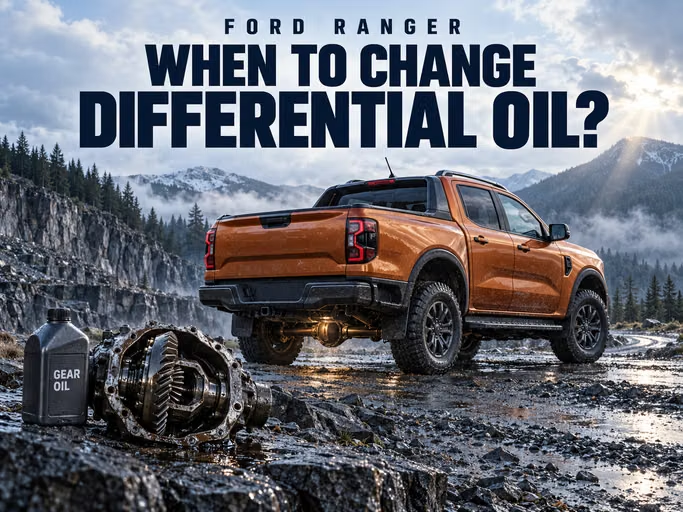
This infographic is illustrative. The highlighted rear axle and enlarged component are conceptual and are not a technical diagram of a specific Ford Ranger version.
A Ford Ranger might spend its week carrying tools, towing a trailer or exploring rocky trails. Those jobs place different demands on its differentials, so there is no single oil-change interval that fits every Ranger. The correct schedule depends on the vehicle’s own documentation, its axle specification and how it is used. Water contamination, a leak or a new whining noise calls for attention regardless of mileage.
This guide explains how axle servicing differs from a transfer-case fluid change, which lubricant specifications appear in Ranger documentation, and why Raptor figures cannot simply be applied to another pickup. Numerical examples come from 2024 model-year manuals. Before buying oil, confirm the VIN and the axle actually installed on the vehicle.
Start by identifying your Ranger’s drivetrain
A rear-wheel-drive Ranger has a rear axle to consider. A 4×4 adds a front final drive and differential, plus a transfer case. These are separate assemblies with separate fluid compartments: changing the automatic transmission fluid does not renew the lubricant in the axles. A workshop description such as “transmission service” is too broad to establish what was done. Ask for each assembly included in the job to be named.
The differential allows the wheels on one axle to turn at different speeds when cornering. Together with the final drive, it transfers torque to the wheels. Its oil protects loaded gear teeth and bearings, helps carry away heat and protects surfaces against corrosion. Even recently replaced oil cannot protect an axle properly if too much has escaped. Fresh lubricant also cannot repair worn components or seal a leaking housing.
Why a trim name is not enough
Before selecting consumables, establish the model year, original delivery market, drivetrain, rear axle type and locking-differential equipment. If an axle has been replaced or the vehicle modified, its original VIN specification may no longer describe the installed assembly. In that case, use the axle identification and replacement records as well. Whether the engine is diesel or petrol does not, by itself, identify the correct axle lubricant.
| Vehicle configuration | What to establish before servicing |
|---|---|
| Ranger 4×2 | Rear axle type and identification; there is no driven front differential to service. |
| Ranger 4×4 | Separate requirements for the front axle, rear axle and transfer case. |
| Ranger Raptor | Its own axle and locker specifications; do not automatically use ordinary Ranger capacities. |
| Ranger with a replacement axle | The installed assembly and its requirements, not just the original VIN build specification. |
Is a locking differential the same as a limited-slip unit?
No. The Ranger owner’s manual treats an electronic locking differential and a limited-slip differential as separate systems. A selectable locker connects the axle shafts for use on suitable surfaces. Having a locker button does not establish that the axle contains a clutch-type limited-slip unit. Consequently, friction modifier is not something to add simply because an axle has a locking function.
Ask the workshop to identify the exact differential and the instruction requiring any additive. If the installed unit’s documentation does not call for one, do not experiment with the oil formulation. Clarifying this before the work starts is much easier than trying to interpret new noises or judder after an unsuitable fluid mixture has been installed.
How often does the oil need changing?
The online 2024 Ranger maintenance schedule lists front and rear axle oil changes at 240,000 km. It also lists 48,000 km for front axle and transfer-case fluid under severe service. However, an exceptions section on the same page says these assemblies do not require scheduled maintenance. This inconsistency means neither statement should be presented as a universal rule: confirm applicability using the vehicle’s own manual and VIN-specific service advice.
How towing, payload and off-road use change the decision
Describe the work the pickup does, rather than reporting annual mileage alone. Extended towing on climbs, a heavy payload, deep sand and repeated wheelspin differ substantially from lightly loaded road driving. The duration and temperature of the operation matter as much as the broad label “off-road use”. A short journey on a smooth gravel track is not equivalent to sustained work through deep sand.
If you prefer preventive axle servicing earlier than the applicable schedule, agree on it separately. Record it as a maintenance strategy for your use, rather than claiming it is a mandatory factory interval for every Ranger. After an axle rebuild, also follow the repairer’s documented instructions: these may include a follow-up inspection or lubricant change after the components have bedded in.
What should happen after a water crossing?
An axle that has been submerged deserves a lubricant and sealing check even if the pickup still drives normally. Inspection should include the breather, seals and signs of damage. Confirmed water contamination requires the cause to be addressed and the contaminated oil replaced; topping up does not remove the water. Do not wait for an obvious milky appearance, because a single clean-looking drop cannot prove the entire oil charge is dry.
An external inspection is useful after muddy journeys as well. Ford’s after-off-road guidance draws attention to underbody damage and accumulated debris. Vibration that appears immediately after a trail can come from mud packed into a wheel, so establish the source before concluding that the differential is responsible.
What if the service history is missing?
For a used Ranger, ask for invoices identifying the axle, lubricant and mileage. An entry saying “all fluids changed” provides little assurance without details. If there is no reliable record, start by identifying and inspecting the assemblies. Agree on further servicing based on their condition, intended future use and diagnostic findings, rather than assuming either that the oil is fresh or that the axle is already damaged.
Which oil and how much does a Ranger need?
The SAE viscosity grade and Ford specification describe different requirements, and both must match the installed axle. A generic “gear oil” description, an API category or a promise of extra protection does not replace the specified approval. Do not choose a thicker lubricant simply because the pickup operates in hot weather or carries a load. Establish the requirement for that assembly first.
The 2024 Ranger rear axle specification table in manual variant 9478 provides the following figures. These illustrate how capacity changes with axle configuration; they are not a universal table for every 2024 Ranger.
| Rear axle in the cited manual | Capacity | Lubricant requirement |
|---|---|---|
| Standard axle, high ride | 1.93 ± 0.03 L | SAE 75W-85; WSS-M2C942-A |
| Locking axle, high ride | 1.73 ± 0.03 L | SAE 75W-85; WSS-M2C942-A |
| Raptor locking axle | 2.35 ± 0.03 L | SAE 75W-85; WSS-M2C942-A |
A different 2024 Ranger manual edition, variant 10276, specifies SAE 80W-90 and WSP-M2C197-A for non-Raptor rear axles: 1.60 ± 0.03 L for standard high ride, 1.19 ± 0.03 L for standard low ride, and 1.54 ± 0.03 L for locking high ride. These are differences in application, not interchangeable oil options. Match “high ride” and “low ride” against the vehicle’s documentation rather than judging its suspension height by eye.
Check the front axle independently
The 2024 manual’s Capacities and Specifications section lists 705 ± 25 ml, SAE 80W-90 and WSP-M2C197-A for a front axle without an electronic locker and without front axle disconnect. A separate Raptor specification lists 775 ± 25 ml for a front axle with an electronic locker, using the same viscosity and Ford specification. These examples apply to the assemblies described, not automatically to every Ranger front axle.
Why pouring in the table’s quantity is not the whole job
The amount purchased and the method used to establish the final level are separate matters. Residual fluid, housing design and the servicing procedure affect the actual refill. Set the level according to the repair information for that axle, with the vehicle in the specified position. Do not assume that the bottom edge of every filler opening is the correct reference point.
Overfilling is undesirable too: it can encourage foaming and fluid discharge through the ventilation system. Ask the workshop to record the amount used and how the level was checked. A small quantity left in the purchased container is not, by itself, evidence that the axle was underfilled. Equally, emptying a complete bottle does not prove the level is correct.
Which symptoms call for diagnosis?
A mileage-based fluid service and fault diagnosis are different jobs. An axle may remain quiet while a leak develops, and a humming noise may come from tyres, a wheel bearing or the driveshaft. Note when the symptom occurs: under acceleration, on the overrun, while cornering, after warming up or only when towing. A clear description helps the technician reproduce and locate the problem.
▪ A new whine or hum that follows vehicle speed and changes under load or on the overrun.
▪ Oil traces on the axle housing, around the driveshaft flange, axle-shaft seals or plugs.
▪ Unusual vibration, knocks when torque reverses, or judder that was not previously present.
▪ Cloudy emulsion, visible water droplets or large metallic particles in the drained lubricant.
▪ A differential-lock or four-wheel-drive fault accompanied by changed vehicle behaviour.
What do colour and metal deposits tell you?
Darkening alone neither sets a replacement deadline nor proves a mechanical failure. Evaluate the lubricant alongside the operating history, odour, evidence of water and the type of particles present. Fine paste on a magnetic plug and individual sharp fragments need different assessments. The amount and source of metal should be evaluated by a technician; there is no useful blanket rule that “metal shavings are normal”.
If a persistent whine is already present, fresh lubricant may alter the sound without restoring damaged gear teeth or bearings. Diagnosis may need checks of play, component condition and adjustment. Do not regard the repair as complete solely because the axle temporarily became quieter after an oil change. The original complaint should be assessed again once the work is finished.
What can happen if you keep driving?
- As lubricant is lost, loaded surfaces receive less effective lubrication; operating temperature and wear can increase.
- Water and contamination undermine protection and can promote corrosion and damage to bearings and gear teeth.
- Wear debris circulates in the remaining lubricant, and the original problem can involve additional components.
- Work that might have involved fixing a leak and replacing the oil can develop into axle disassembly and repair.
Do not try to silence the symptom with an arbitrary additive. Where a leak is found, the workshop needs to establish whether it comes from a seal, housing damage, a plug or a ventilation problem. Repeated top-ups without finding the cause leave the risk of further fluid loss unresolved and provide no reliable picture of the assembly’s internal condition.
What should a proper differential service include?
A sound service starts with an agreed scope, before the old oil is drained. The sequence below is a useful owner’s checklist; tightening torques, sealing products and the detailed procedure must come from the documentation for the installed axle.
- Identify the assembly, confirm the lubricant and inspect the housing, seals and breather. Before draining, make sure the filler plug can be accessed and removed.
- Secure the vehicle in the required position. Collect the used oil in a clean container so contamination and evidence of water can be assessed.
- Drain the assembly using its specified method. If the cover must be removed, clean the mating surfaces and use the required gasket or sealing compound.
- Refill with the correct lubricant, establish the level by the prescribed method and tighten fasteners to specification. Do not substitute solvent or an arbitrary flushing product for the specified service.
- After a check drive, inspect for leaks and reassess the original complaint. Record the date, mileage, fluid specification, quantity and work carried out.
| Information on the invoice | Why it matters |
|---|---|
| The assembly serviced | Distinguishes the rear axle, front final drive and transfer case. |
| Full lubricant name and specification | Makes the selection verifiable and helps identify the same fluid if it is needed again. |
| Quantity, seals and findings | Explains the work and preserves evidence of leaks, water or wear debris. |
Questions Ranger owners ask
Is topping up enough for a small leak?
Topping up restores quantity, not sealing. Find and correct the cause, then assess whether the axle has operated with insufficient lubricant. Whether further driving is appropriate depends on the rate of loss and the inspection findings.
What should you ask when buying a used Ranger?
Ask about towing, water crossings, axle repairs and locker servicing. When comparing current offers, assess records and drivetrain condition alongside mileage: a low odometer reading does not describe how hard a working pickup has been used.
Conclusion
Correct Ford Ranger differential maintenance begins with identifying the installed axles. Confirm the schedule and lubricant for your vehicle, account for its workload and investigate water exposure or leaks promptly. The right specification, a correctly established level and a clear service record are more useful than a single mileage rule applied to every Ranger.