How often should you change the fuel filter on a Ford Ranger?
Ford Ranger
Ford Ranger•
•7 views
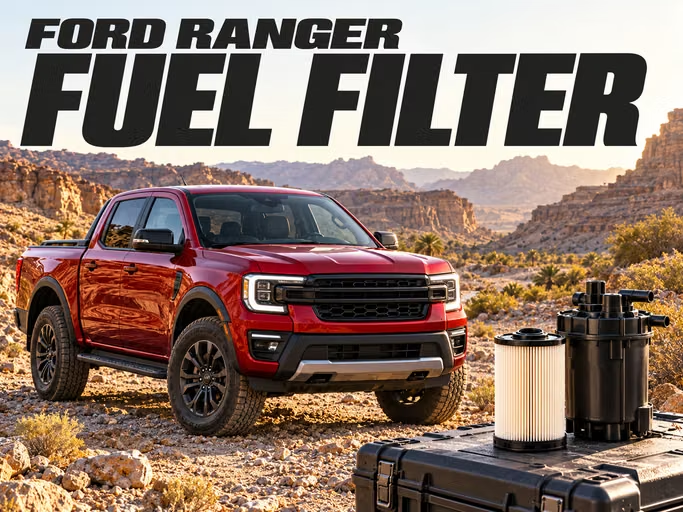
Illustration for general reference only. The foreground filter element and housing are illustrative; their design depends on the Ranger’s engine and model year. Verify parts compatibility by VIN.
There is no single fuel-filter replacement interval for every Ford Ranger generation and engine. A diesel requires attention to both its filter and water separator, while a petrol version needs its particular system identified first. Follow the applicable schedule for routine replacement, and investigate warnings or running problems promptly even if the next service is some distance away.
For a pickup carrying tools, towing a trailer or travelling beyond paved roads, dependable fuel delivery matters particularly under load. This article explains how to find the right maintenance requirement, distinguish water accumulation from a delivery restriction and agree repairs without unnecessarily replacing a pump. It also covers starting problems that appear immediately after filter service.
Diesel and petrol Rangers have different requirements
What does a diesel Ranger need?
The diesel filter section of the 2024 Ranger manual calls for replacement at the applicable service interval and when the low fuel pressure message appears. That section does not give one mileage limit for every version. Obtain the specific requirement from the schedule that applies to the vehicle, including any additional operating-condition requirements.
When booking a service, ask for the fuel-filter entry rather than the general service interval. Check whether a time limit also applies and which limit comes first. An oil change, a water-separator check and a new filter element can be separate operations. An invoice saying ‘all filters’ does not establish what was actually done to the fuel system.
Why should petrol versions be checked separately?
One edition of the Ranger owner’s manual describes an integrated in-tank filter with no regular replacement requirement. However, the 2024 Ranger manual contains an instruction to replace the filter according to the applicable schedule. It is therefore incorrect to describe every petrol Ranger as having a lifetime filter, or to give it a diesel’s interval. Use documentation that matches the VIN and installed system.
| Vehicle situation | What to establish | What is insufficient |
|---|---|---|
| Diesel Ranger | Filter replacement requirement and water-separator maintenance | The general engine-oil interval |
| Petrol Ranger | Whether this version has scheduled replacement | Advice for another generation |
| Unknown service history | Last replacement, part number and inspection findings | A seller saying it was recently serviced |
If documents conflict, do not automatically choose either the longest or the shortest interval. Check the model year, engine and build date, and ask the workshop to confirm which schedule applies. A missing entry in a general service checklist does not prove that the fuel filter is a lifetime component.
Water in Fuel and Low Fuel Pressure are different warnings
What should you do when the water warning appears?
On a diesel, Water in Fuel concerns water in the fuel system, not the coolant level. The Ranger water-separator instructions require a safe stop, engine shutdown and draining of the accumulated water. Continuing with water present can damage the injection system. If you are unfamiliar with your assembly and its procedure, arrange professional assistance.
Draining water and replacing the filter element are separate tasks. Draining alone does not mean scheduled replacement has been completed. If the warning returns, repeatedly draining the separator or clearing the message is not enough: the cause, fuel condition and assembly operation need checking. Tell the technician when the warning appeared and whether the pickup had recently been refuelled.
What does a low fuel pressure message mean?
Low Fuel Pressure calls for attention to fuel delivery. For the diesel version covered by the manual above, it is also a reason to service the filter. It does not, however, provide a complete diagnosis of a failed pump or injectors. Ask for testing according to the procedure for your engine and an explanation of the findings that justify any further repair.
Which symptoms can accompany a filter problem?
The filter-maintenance guidance on me.ford.com identifies jerking at high engine speeds and starting difficulties as possible signs. These observations help the owner describe the complaint and the workshop begin its investigation. Similar symptoms can have different causes, so choosing a replacement part from one symptom alone is unreliable.
● Hesitation under load. Record whether it happens on a hill, with cargo or after the engine warms up. Do not investigate through aggressive overtaking or towing a heavy trailer. Stop the journey if the pickup cannot maintain safe, dependable performance.
● Extended cranking. Distinguish a slowly turning starter from an engine that cranks at normal speed but takes time to start. Note the difference between cold and hot starts. This helps separate a delivery concern from other possible causes.
● Uneven running and stalling. Explain whether the problem occurs at idle, while driving or immediately after servicing. Preserve messages and fault information. A successful restart does not establish that the underlying problem has disappeared.
● Changes after refuelling. Keep the receipt and record the time and approximate fuel level before filling up. A timing connection is useful but does not prove that the fuel is responsible. Avoid trying to compensate for severe running problems with an arbitrary cleaner.
Can the filter be responsible for higher consumption?
Consumption alone does not reveal the filter’s condition. Ford’s fuel-saving guidance discusses tyre pressure, additional weight, acceleration habits and extended idling. For a Ranger, compare similar trips first: an empty pickup on the motorway and a loaded vehicle on a work route operate under different conditions.
If consumption rises alongside a loss of performance, report both changes. If the engine runs smoothly, start by reviewing operating conditions and measuring consumption consistently over several fill-ups. Replacing a healthy filter should not be presented as a guaranteed way to achieve a particular percentage saving.
Where is the filter, and what gets replaced?
The assembly’s location varies. For example, the instructions for a Ranger with the 3.2 diesel refer to the under-bonnet layout when locating the water separator, while the newer diesel Ranger manual shows an assembly beneath the frame. Advice that it is always under the bonnet or always beside the tank can therefore send you looking for the wrong component.
Before buying anything, establish whether the repair requires a cartridge, a complete filter housing or another assembly. Check the supplied seals, connections and compatibility with a water sensor where fitted. Similar dimensions do not guarantee suitable filtration or sealing. For a petrol system with an integrated filter, establish separately which repair the vehicle’s service information permits.
Why might a Ranger become difficult to start after replacement?
If starting was normal before the service and became difficult immediately afterwards, report that sequence before authorising more parts. Initial checks should prioritise correct installation, seals, connections and completion of the prescribed fuel-system priming procedure. This does not prove a technician made a mistake, but it gives the investigation a useful starting point.
Do not try to overcome the problem through endless cranking. Filling and air-removal procedures vary, so a universal instruction specifying a certain number of ignition cycles will not suit every Ranger. The workshop should follow the procedure for the installed engine, then check for leaks and verify restarting. Clearing a fault without addressing its cause is not a completed repair.
Dusty routes, heat and fuel quality
Cargo carrying, towing and extended idling should be considered when selecting the maintenance schedule. However, dust on the body does not mean the fuel filter is as dirty as the air filter. Do not independently assign the same mileage interval to every filter. Tell the workshop which conditions are routine and which involved only an occasional trip.
Before travelling to a remote area, review the service history and resolve existing symptoms. If a replaceable filter is approaching its scheduled limit, arrange the work early enough to verify the result. Avoid untested repairs immediately before departure, when difficult starting or a leak might only become apparent on the journey.
Will an additive help, and can the filter be cleaned?
The manual’s diesel fuel-quality section recommends fuel meeting the required specification from a trusted supplier and does not recommend aftermarket additives for normal use. A cleaner does not replace water removal, replacement of an exhausted element or investigation of contamination. Check whether a particular product is approved rather than relying on its packaging claims.
Service a replaceable element according to the prescribed procedure. Do not assume that washing or blowing it out is acceptable simply because it looks cleaner afterwards. Where fuel contamination is confirmed, ask the workshop to investigate the source: installing a fresh filter does not automatically make the tank contents suitable for use. For prolonged vehicle storage, consult the fuel requirements in the applicable manual.
Agreeing the work and checking the result
Cost depends on the assembly and the work required: replacing an element, a housing and a complete pump module are different jobs. Request separate entries for diagnosis, parts, seals, labour and final verification. A broad description such as ‘fuel-system repair’ is insufficient for comparing quotations or understanding the expense.
● Before authorising the work. Obtain the part number and confirmation of VIN-based compatibility. If a pump or injectors are also proposed, request the results of testing those components. A warning message alone does not determine the complete shopping list.
● At collection. Ask whether the workshop checked for leaks, verified restarting and tested operation under the original complaint conditions. After water-separator service, the dashboard warning also needs assessment. Returning indications require further investigation.
● For the next service. Keep the date, mileage, part number and precise description of the operation. Record filter replacement separately from water draining. Set the next service requirement from the applicable schedule rather than an engine-oil reminder reset.
Conclusion
Replace the Ford Ranger’s fuel filter according to the schedule for its engine and specification. On a diesel, maintain the water separator separately and respond promptly to warnings; on a petrol version, first establish whether routine replacement is required. After servicing, correct priming, leak-free operation and verification of the original complaint are essential.
When choosing a used Ranger, compare current offers and request its fuel-system service history. Find out what was replaced, why repairs were carried out and whether warnings returned. Those details help assess the pickup for both everyday work and journeys beyond the city.