


When to change engine oil in a Ford Expedition
Ford Expedition
Ford Expedition•
•9 views
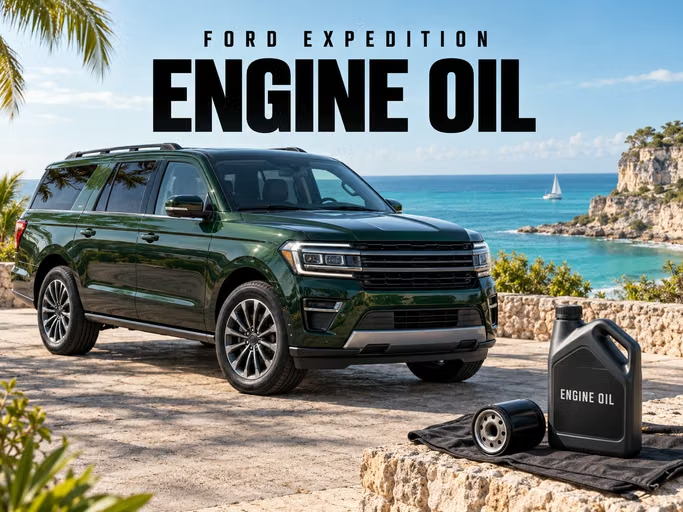
The cover illustrates engine maintenance and the Expedition’s touring character. The vehicle and service items may differ from your version. The image does not replace technical documentation.
A Ford Expedition often carries a large family, luggage or a trailer. Yet much of its working week may be spent in traffic or waiting for passengers with the air conditioning running. That is still engine operating time, even when mileage barely increases. Oil-change timing should reflect the requirements of the particular Expedition and how it is actually used.
For UAE operation, it is especially important to distinguish the general maximum interval from regional hot-climate requirements. This article explains when to arrange servicing, how to select oil and a filter, what to check before travelling and which symptoms need diagnosis. Numerical examples refer to the 2025 Expedition owner’s manual; other model years require separate verification.
Start with the vehicle details
Confirm the VIN, model year and engine. Registration year, trim name and a similar appearance do not always identify the correct service items. A product description saying “for Ford” or “for EcoBoost” is too broad: application to the individual vehicle matters.
For an Expedition with the 3.5-litre EcoBoost engine, do not automatically adopt recommendations for another Ford with the same engine displacement. Check the manual for your model and year. If the lubrication system has been modified, the engine replaced or other alterations made, establish which components remain standard.
Find the latest service invoice. You need the change date and mileage, oil specification, quantity used and filter part number. A consistent sequence of records helps establish the next service deadline. Where the history is unknown, discuss an engine assessment and initial service with the workshop instead of counting the interval from the purchase date.
How often to change oil in a hot climate
The 2025 Expedition maintenance schedule gives a general ceiling of one year or 16,000 km between services. However, the same manual includes a separate Hot Climate Oil Change Intervals exception. For the Middle East, it states 5,000 km under its described conditions involving API SM or SN oils.
That exception belongs to a particular manual edition and does not make 5,000 km a universal rule for every Expedition generation. Compare it with your vehicle’s local service documentation and the schedule confirmed for its VIN. An earlier applicable time limit, distance limit or vehicle message takes effect before the general maximum.
The API categories mentioned in the regional exception do not override the viscosity and Ford specification required by the engine. There is no reason to deliberately seek an older-category product or choose unsuitable oil on the assumption that frequent replacement makes it acceptable. Confirm the oil’s suitability first, then establish the interval.
After servicing, record both the next date and odometer reading. This is particularly useful when the vehicle alternates short daily trips with occasional journeys covering several thousand kilometres. If the time limit arrives first, low mileage does not automatically justify delaying the visit.
Can you rely only on Oil Life
The Intelligent Oil-Life Monitor helps determine when a change is needed based on vehicle use. Its remaining-life percentage does not measure the oil quantity in the sump. A normal display reading does not rule out leakage, a low level or a lubrication-system fault.
The 2025 manual’s oil-life monitor section recommends replacing the oil within two weeks or 800 km after the relevant reminder. This is a response period for a service message, not permission to keep driving with an emergency pressure warning. When planning a journey, also account for any earlier requirement in the applicable schedule.
Reset the counter after the oil and filter have actually been replaced. If it is reset accidentally, use the service records to reconstruct the deadline and confirm it with the workshop. The new screen reading cannot show how long the oil had already been in use before the reset.
Why the driving pattern matters
Waiting with the air conditioning running
Extended idling adds engine operating time without adding much distance. A family route with several stops may involve more waiting than driving. Explain that routine when discussing service timing, especially if it happens every day.
A high outside temperature does not guarantee that the oil reaches its working temperature during a short trip. The manual associates frequent short journeys, prolonged idling and low-speed operation with possible increases in oil level. This is a reason to monitor the level, rather than treating low mileage as proof of light use.
Towing and heavy loads
A trailer, passengers and luggage change the engine’s workload, particularly on climbs and in high temperatures. The manual identifies heavy loading and towing as severe operating conditions. Regular trailer use calls for checking the applicable maintenance schedule rather than copying the habits of an owner whose Expedition does not tow.
Having a towbar fitted does not itself determine the interval: actual use matters. Confirm trailer and loading limits from your vehicle’s documentation. Fresh engine oil does not increase permitted loads or replace checks on the brakes, tyres and cooling system.
If an oil change will fall due during a journey, arranging it beforehand is more convenient. Allow time for a check drive, another level check and an inspection for leaks. That is more useful than discovering the result of the work for the first time on a remote part of the route.
Sand and dust
Dusty routes require attention to more than oil. Inspect the engine air filter and intake sealing using the procedure for the particular version. An oil filter does not replace an air filter, and fitting a new air filter does not cancel an oil change that is due.
After a demanding journey, inspect the vehicle for damage and leaks. Do not assign a new universal mileage interval solely because of one trip on unpaved roads. Consider its duration, load, warnings and the manual’s requirements.
Which oil does the Expedition require
The oil specification section of the 2025 Expedition manual lists SAE 5W-30 and WSS-M2C961-A1. The capacity including the oil filter is 5.7 L. Check these figures against your own vehicle’s documentation, especially for a different model year or a non-standard configuration.
Viscosity and specification are different requirements. A 5W-30 label does not automatically establish compliance with WSS-M2C961-A1. Check both on the packaging and in the product’s technical information; descriptions such as “synthetic” or “for turbo engines” are insufficient on their own.
Do you need thicker oil in summer
Do not select thicker oil solely because of hot weather without support in the vehicle documentation. The manufacturer specifies requirements for the engine’s lubrication system, and an arbitrary viscosity change does not replace an appropriate service schedule. Unusual oil consumption first requires consistent measurements and investigation of its cause.
If a workshop suggests a different product, ask it to explain the application to your VIN and engine. The decision should follow confirmed requirements, rather than outside temperature or vehicle mileage alone. Supplemental additives are not a necessary part of an oil change: the manual warns that they are unnecessary and can damage the engine.
Can you pour in the entire container
The quantity purchased and the engine’s fill capacity are different things. The specified 5.7 L includes the filter, but the actual level still needs checking after servicing. Do not add the remaining contents merely to empty the packaging, and do not exceed MAX.
For topping up, record the required specification or keep a photograph of the oil label used at the service. Carry any spare oil in its original, closed container secured against movement. A top-up restores the level; it does not restart the oil’s service interval or repair the cause of oil loss.
The filter and the scope of servicing
Replace the oil filter with the oil. The 2025 Expedition service-parts list specifies Motorcraft FL-500-S; where that filter is unavailable, it calls for compliance with SAE/USCAR-36, Type C. This is a reference for the stated edition, not confirmation that any similar-looking filter is suitable.
VIN-based selection is especially relevant when a seller combines several generations and engines in one product description. A similar thread or seal size does not establish the required operating performance. Retain the fitted part number in the service records.
Before work begins, confirm what the price includes: correctly specified oil, the filter, required seals, access to the drain and filter, a final level check, leak inspection and reminder reset. Comparing totals alone is less useful when the scope of work differs.
Do not automatically add an engine flush because the oil is dark or the vehicle has high mileage. If contamination is suspected, establish its cause and assess the engine first. After a routine change, the practical priorities are the correct level, no leaks and a recorded next service deadline.
How to check the oil level correctly
According to the 2025 Expedition level-check procedure, the vehicle must stand on level ground. Check before starting the engine, or after warming it up, switching it off and waiting 15 minutes. This allows oil to drain into the sump; measuring immediately after shutdown may give an inaccurate result.
- Switch off the engine and establish safe access under the bonnet.
- Remove the dipstick, wipe it with a clean lint-free cloth and insert it fully again.
- Withdraw it again and read both sides. The manual specifies using the lower reading.
- No top-up is needed if the level is between MIN and MAX. At the minimum mark, add suitable oil while observing safe topping-up conditions.
- Add small amounts and check again. Do not exceed MAX, and fully reinstall the dipstick.
Record mileage and top-up quantities, comparing measurements taken under consistent conditions. Make additional checks before a long journey and during demanding use. For the higher-consumption operating patterns it lists, the manual calls for a level check at every fuel stop.
Signs that need attention between services
Fresh spots beneath the vehicle, a noticeable increase in top-ups, unusual noise and a persistent level above maximum require investigation. Do not try to solve the problem simply by changing the oil more often. Tell the workshop when the symptoms began, how much oil was added and how the vehicle was being used.
Darkening alone does not determine replacement timing. Assess it alongside the service history, level and other signs. If leakage appears after servicing, have the result checked promptly rather than waiting until the next scheduled visit.
What to ask before buying a used Expedition
When reviewing current offers, compare the service history with the vehicle’s actual use. Ask about towing, idling and long-distance journeys. Low mileage without records does not explain the engine’s workload.
Check the sequence of invoice dates and mileages and the details of the oil and filters used. A fresh pre-sale change does not replace diagnosis. If records are limited, budget for an inspection and an agreed initial service so that future intervals start from documented work.
Owner checklist
☐ Identify the model year, engine and VIN-specific requirements.
☐ Compare the local schedule, last change date and Oil Life messages.
☐ Account for regular towing, short trips, dust and idling.
☐ Select oil by viscosity and specification, and a filter by confirmed application.
☐ After the change, check the level, absence of leaks and reminder reset.
☐ Retain the invoice and record the next service date and mileage.
Conclusion
Ford Expedition servicing should account for the engine, regional schedule and workload. For a large family vehicle, stationary running time and towing can matter as much as distance. Suitable oil, a new filter and level checks between services help keep it prepared for everyday routes and longer journeys.


