


How often should you change the fuel filter on a Ford Expedition?
Ford Expedition
Ford Expedition•
•10 views
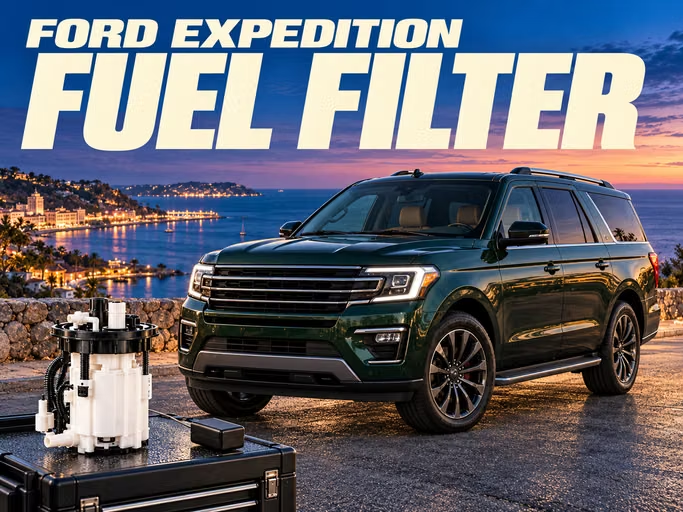
Illustration for general reference only. The foreground fuel module is illustrative; its design varies by Expedition version. The image is not a technical diagram or a substitute for VIN-based parts identification.
The Ford Expedition appeals to drivers who need a spacious cabin for family journeys and plenty of luggage. Yet the question of when to replace its fuel filter begins with the vehicle specification, not its mileage. First establish whether your particular version has a separately scheduled filter replacement. Expedition fuel systems vary, and for certain model years even the wheelbase makes a difference.
This article covers petrol-powered Expeditions: what to check before ordering a filter, which symptoms deserve attention and how to assess a workshop’s recommendation to replace a fuel module. Keep scheduled maintenance separate from fault repair. Maintenance follows the applicable documentation; repair needs a diagnosis, rather than an odometer reading alone.
When does the filter actually need replacement?
The 2026 Expedition owner’s manual describes a filter integrated with the fuel tank that needs no regular maintenance or replacement. For a vehicle covered by that instruction, buying one at every second service is unnecessary. However, the absence of a scheduled replacement does not rule out repair when a fault is confirmed.
Earlier vehicles require a closer look. The 2009 Expedition owner’s guide specifies a lifetime in-tank filter for the short-wheelbase version. Its maintenance arrangement should therefore not be assumed to apply to the long-wheelbase Expedition EL of the same model year.
| Example version | Maintenance arrangement | Owner’s next step |
|---|---|---|
| 2026 Expedition | Integrated filter; no scheduled replacement | Confirm the manual applies; investigate symptoms if present |
| 2009 Expedition, short wheelbase | Lifetime filter inside the tank | Do not authorise replacement based on mileage alone |
| 2009 Expedition EL, long wheelbase | Scheduled filter replacement | Check the normal and special operating schedules |
For the 2009 Expedition EL, the maintenance guide specifies 30,000 miles, approximately 48,000 km. Under its listed dusty conditions or extensive idling and low-speed commercial operation, the interval is 15,000 miles, approximately 24,000 km. These are specific examples, not universal figures for every Expedition or MAX.
What does a lifetime filter mean for the owner?
It means there is no regular replacement task in the schedule, rather than a promise that every component can never fail. If a workshop recommends intervention, ask what prompted it: a scheduled service for a replaceable filter, a confirmed delivery restriction or a fault elsewhere in the module. Those situations involve different work and should not all be hidden behind the same description, ‘fuel filter replacement’.
Which symptoms deserve investigation?
A fuel-delivery problem may feel different with an empty vehicle and with passengers aboard. Recording when it happens is useful, but the driving sensation cannot confirm a clogged filter. The filter guidance on me.ford.com lists jerking at high engine speeds and starting difficulties as possible signs, while recognising the need to check other causes.
● Hesitation during acceleration. Note whether it happens after warm-up, on a climb or when joining a main road. If the vehicle cannot maintain dependable performance, do not investigate through overtaking or hard acceleration. Leave controlled reproduction of the symptom to the workshop.
● Jerking or uneven running. Describe whether the engine itself seems to stumble or the jolt coincides with a gear change. Record dashboard messages and preserve fault information before the appointment. A fault code on its own does not identify the replacement part to buy.
● Long cranking before starting. Distinguish a slowly turning starter from an engine that cranks normally but takes time to fire. Explain whether it happens in the morning, after a brief stop or only when warm. This is more useful than assuming the filter is responsible.
● Repeated stalling. Restarting successfully does not mean the underlying problem has gone away. Note the fuel level, engine temperature and circumstances of the stall. Do not postpone investigation until the next scheduled service.
● A change immediately after refuelling. Keep the receipt and record when the symptoms began. A timing connection helps the investigation but does not prove contaminated petrol. Avoid trying to hide severe running problems with an arbitrary fuel additive.
Does higher fuel consumption mean the filter is blocked?
Fuel consumption alone cannot establish that diagnosis. Ford’s fuel-saving guidance identifies other influences, including tyre pressure, unnecessary weight, aggressive acceleration and extended idling. A steady motorway trip in a family Expedition is not a fair comparison with an urban route involving frequent stops.
Compare several fill-ups under similar conditions rather than one display reading just after resetting the trip computer. Record changes in the route and vehicle load. If increased consumption comes with hesitation, difficult starting or an engine warning, tell the workshop. A promise of a substantial economy improvement simply by replacing a healthy integrated filter needs a technical explanation.
Heat, dust and long journeys: what matters?
Give the workshop an accurate description of use: regular dusty roads, long waits with the engine running, passenger loads and towing. Then consult the applicable schedule. There is no sound basis for automatically halving every interval because the climate is hot, or for applying an older EL maintenance requirement to a modern MAX.
The condition of the engine air filter does not establish how clean the fuel filter is. They belong to different systems, and contamination in the tank needs its own assessment. Higher octane is not a way to clean a filter element either. Choose fuel that meets your vehicle’s manual; petrol quality and the required octane rating are separate questions.
Should you replace the filter before a trip just in case?
If a scheduled replacement is due, completing it before departure makes sense. If the filter has no scheduled service and the vehicle has no symptoms, an upcoming journey alone does not justify opening the tank. Where running problems exist, identify the cause first and allow time to verify the repair. A brief start outside the workshop does not prove that a fault occurring only after a long drive has been resolved.
When preparing an Expedition for towing, tell the workshop about the trailer and stay within the vehicle’s limits. Temperature warnings or changes in transmission behaviour are separate diagnostic clues. Avoid attributing every issue in a heavily loaded SUV to its fuel filter.
How can you assess whether repair is justified?
Begin with a straightforward question: what was measured, and which result was outside specification? Delphi’s fuel-delivery testing guidance covers pressure, flow and electrical checks. The values and test conditions for an Expedition must match its installed system, rather than a universal procedure taken from a video.
Low pressure does not always mean the pump itself has failed. The technical explanation of voltage-drop testing shows how poor connections or grounds can affect delivery. A recommendation to replace an expensive module should account for its electrical supply instead of relying on one pressure reading.
| Question to ask | A useful workshop answer | Why it matters |
|---|---|---|
| What fault was found? | Test results and applicable specifications | Separates diagnosis from a replacement based on a guess |
| Which assembly is being replaced? | Filter, pump or module with an exact part number | Makes quotations comparable |
| Is contamination present? | Evidence and a plan to address its cause | Helps prevent a repeat repair |
| How will the result be checked? | Leak checks and operation under suitable conditions | Connects the handover to the original complaint |
Where is the filter, and must the whole module be replaced?
For versions with an integrated filter, looking for a separate routine service item outside the tank is the wrong starting point. On a vehicle with a replaceable filter, confirm the location and access procedure in its service information. An inlet strainer, fine filter and complete pump module are different items. A separate component appearing in a retailer’s catalogue does not establish an approved repair for your vehicle.
Ask for the proposed assembly’s part number and what the package includes. Sometimes ‘module’ describes several components; another quotation may cover only a pump. Appearance, connector shape or a broad ‘fits Expedition’ label does not establish compatibility. Compare model-year and body-configuration restrictions carefully.
Can the filter be washed or treated with an additive?
Do not treat an additive as a substitute for scheduled maintenance or diagnosis. Cleaning a particular element needs support from the applicable procedure, not simply a claim on a bottle. Delphi’s contaminated-pump case study explains why contamination left in a tank can cause another problem after repair. Address the source when contamination is confirmed; vehicle age alone does not prove that tank cleaning is required.
Agreeing the cost and checking the completed work
A general price for ‘Expedition fuel filter replacement’ means little without its scope. Servicing a separate filter and repairing the vehicle with a replacement module are different jobs. Ask for a breakdown covering diagnosis, parts, necessary seals, labour and final checks. Compare quotations with matching part numbers and work content, rather than totals alone.
● Before authorising the work. Confirm VIN-based fitment, the manufacturer and the warranty. An alternative component needs verified specifications and compatibility. A familiar brand name cannot compensate for selecting the wrong part.
● At collection. Ask what confirms that the original complaint has been resolved. Starting the engine and finding no new code do not replace every required check. If the fault appeared only when hot, the verification should take that into account.
● For the service history. Keep the repair reason, date, mileage, part numbers and checks performed. For a scheduled filter replacement, record the next interval from the correct guide. Do not automatically link it to resetting the engine-oil service reminder.
Conclusion
The Ford Expedition’s fuel filter should be maintained according to the documentation for the particular vehicle. Follow the applicable schedule where regular replacement is specified; with an integrated lifetime filter, establish the reason for repair through diagnosis. Wheelbase, model year and service history are more useful than a universal recommendation to replace everything at a certain mileage.
If you are choosing a used Expedition, compare current offers and request the previous service records. Find out why any fuel-system work was carried out and whether it resolved the original complaint. Those details help assess the vehicle’s readiness for everyday driving and family journeys.


