


How quickly does the BMW X2 accelerate from 0 to 100 km/h?
BMW X2
BMW X2•
•7 views
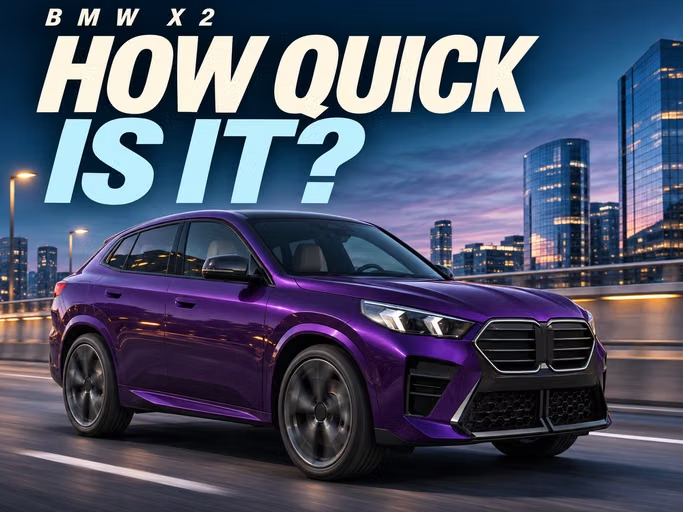
Editorial illustration. Vehicle appearance is illustrative; acceleration figures apply to specific versions and markets.
The second-generation BMW X2 reaches 100 km/h in 8.3 seconds as an sDrive20i and in 5.4 seconds as an M35i xDrive, according to the manufacturer's regional website. That 2.9-second gap shows how differently two cars bearing the same X2 name can perform. For a buyer in the UAE, sporty bodywork alone does not establish what a particular car can deliver.
This article focuses on petrol versions of the U10 generation, which went on sale in 2024. The earlier F39 is discussed separately, because its figures should not be transferred to the newer body. We also distinguish between acceleration to 100 km/h and the American 0–60 mph measurement. The electric iX2 is outside this comparison.
How quickly does the BMW X2 sDrive20i reach 100 km/h?
The published figure for the U10 sDrive20i is 8.3 seconds. The technical information on bmw-me.com lists an output of 125 kW, or 170 metric horsepower. This is a reference for that particular version, rather than a universal figure for every petrol X2.
For buyers, the number provides a useful starting point. It separates the sDrive20i's performance from the M35i's capabilities, but says little about smoothness in traffic, response to a gentle accelerator input or ease of parking. Those qualities may matter more in daily ownership than a few seconds during a standing start.
Read the complete model designation. If an advert shortens it to “X2 20i”, establish the generation, original market and exact variant before matching it to a specification sheet. Similar badges are not enough to confirm identical performance.
How much quicker is the BMW X2 M35i xDrive?
The U10 M35i reaches 100 km/h in 5.4 seconds. Its official regional model page lists 300 metric horsepower and 400 Nm. Compared with the sDrive20i, the time falls by 2.9 seconds, or approximately 35%. That describes a reduction in elapsed time; saying simply “35% faster” leaves the measurement unclear.
The M35i also has xDrive* and its own chassis specification. It is a distinct performance variant, not merely a different bumper and wheel package. However, its advantage from rest should not be assumed to remain identical during every overtaking manoeuvre. Standing starts and acceleration while already moving measure different aspects of performance.
* xDrive is BMW's designation for its all-wheel-drive system.
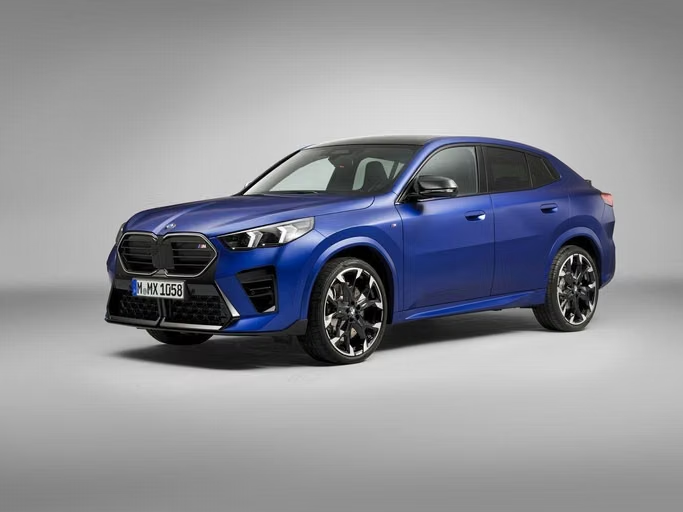
BMW X2 U10. Body shape helps distinguish the generation; documentation establishes the exact variant. Model photograph.
Does M Sport mean the same performance as an M35i?
No. M Sport denotes an equipment package, while M35i identifies a model variant. The distinction is explicit in BMW's Irish launch information: the sDrive20i M Sport is listed at 8.3 seconds, alongside the M35i xDrive at 5.4 seconds.
An advert describing an “X2 M Sport” therefore does not establish M35i performance. A sports steering wheel, large wheels or M detailing cannot replace the complete model designation. This matters when comparing asking prices: a premium for equipment and a premium for a more powerful drivetrain should be considered separately.
A used car's appearance may also have been changed after delivery. Original equipment information is a stronger basis for identifying its specification than photographs of a grille or steering wheel.
Why does the previous X2 M35i have a 4.9-second figure?
That number belongs to the first-generation F39. In its global announcement from September 2018, BMW quoted 306 metric horsepower, 450 Nm and a 0–100 km/h time of 4.9 seconds for the X2 M35i. The release also described an eight-speed Steptronic transmission.
The figure is therefore not necessarily an error or evidence of tuning. The mistake arises when it is placed beside U10 specifications without explanation. Even an unchanged M35i badge does not mean the underlying configuration is unchanged.
Nor must a new generation improve every timed measurement. Buyers also assess accommodation, equipment and road behaviour. A half-second difference alone cannot establish which car is better overall or explain the precise engineering reason behind the change.
Why is the American 5.2-second figure not a 0–100 km/h time?
It measures a different speed interval. The US announcement for the 2024 X2 quotes 5.2 seconds to 60 mph for the M35i. That speed is approximately 96.6 km/h, so the measurement ends before the car reaches 100 km/h.
Simply changing the unit label is incorrect. Adding a fixed 0.2 seconds to every American figure is also unreliable, because the remaining acceleration and test method matter. For an imported car, retain the original description: “0–60 mph* in 5.2 seconds, US specification”.
* mph means miles per hour; 60 mph is approximately 96.6 km/h.
A meaningful comparison requires matching measurements. Where a confirmed 0–100 km/h result is unavailable for a particular version, leaving it unspecified is more accurate than inventing a conversion.
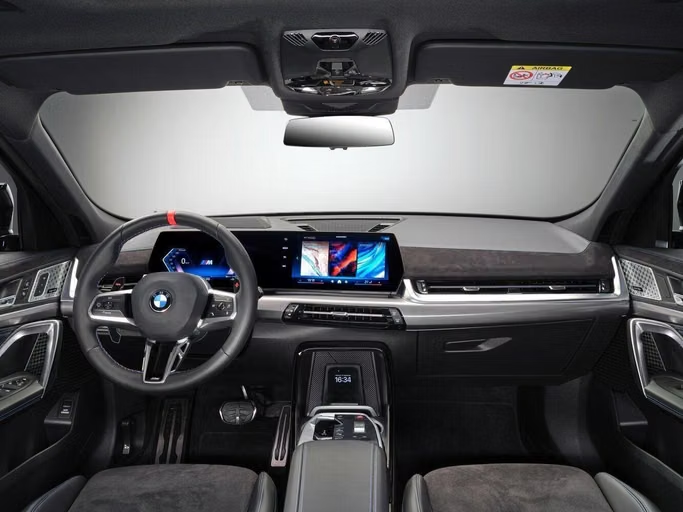
BMW X2 U10 interior. Sporting cabin details alone do not establish engine output. Interior photograph.
What does the M35i transmission tell buyers about performance?
The U10 M35i uses a seven-speed Steptronic transmission with two clutches. This should not be confused with the earlier F39's eight-speed transmission. Gear count alone cannot predict acceleration: the complete powertrain, ratios and available tyre grip all contribute.
For construction and maintenance details, see “B48 and the Steptronic transmission in the BMW X2 U10 M35i xDrive” — LINK. The distinction is practical: published performance helps identify the right version, but it does not diagnose the condition of an individual engine or transmission.
Will a used X2 reproduce its published acceleration time?
Not necessarily. Vehicle load, tyre condition, road surface and temperature affect the conditions of an acceleration run. A single owner's measurement cannot automatically be treated as directly comparable with a manufacturer figure. In the UAE, an isolated start in hot weather is particularly unhelpful as a definitive verdict on performance.
Missing the quoted time does not, by itself, prove a turbocharger or transmission fault. Equally, approaching that time once does not establish that the whole car is healthy. Acceleration describes behaviour; assessing mechanical condition requires a separate inspection.
Which BMW X2 makes sense when acceleration matters?
For the U10 versions considered here, the reference points are clear: 8.3 seconds for the sDrive20i and 5.4 seconds for the M35i. The latter deserves attention when strong acceleration is a central reason for buying. If design and everyday usability come first, judge an M Sport package by its equipment without assuming M35i performance.
When browsing current offers, separate generations and variants before comparing prices. A premium becomes meaningful when you know whether it buys equipment, a newer car or a particular level of performance. The full model designation turns an impressive acceleration claim into a useful purchasing criterion.


