What transmission does the BMW 7 Series have, and how reliable is it?
BMW 7 Series
BMW 7 Series•
•13 views

Article illustration. Vehicle and transmission details are illustrative; this is not a repair diagram.
Pre-facelift BMW 740i/740Li and 750i/750Li models in the G11/G12 generation use eight-speed ZF 8HP automatics. The same number of gears does not mean the same transmission, however. The six- and eight-cylinder versions use different units, and reliability must be assessed on the individual vehicle.
For a used 7 Series buyer, maintenance history and behaviour after warming up matter more than a seller’s claim of a “lifetime gearbox”. This guide covers petrol versions before the 2019 facelift, symptoms worth investigating and fluid selection. Hybrids, facelifted G11/G12 cars and the later G70 generation require separate checks; their specifications and servicing should not be mixed with those of early cars.
Which automatic transmissions are fitted to the G11/G12?
The main petrol versions use different transmission designations. G11 identifies the standard wheelbase and G12 the long wheelbase. The 740i badge alone does not establish body length: the US-market long-wheelbase car also used that name. The model catalogue helps distinguish generations, but servicing and replacement parts require factory identification.
| Pre-facelift version | Engine | Transmission family |
|---|---|---|
| 740i / 740Li | 3.0-litre inline six, B58 | ZF 8HP50; BMW designation GA8HP50Z |
| 750i / 750Li | 4.4-litre eight-cylinder, N63TU2 | ZF 8HP75; BMW designation GA8HP75Z |
This table covers early petrol applications. Verify drivetrain, production date and the complete unit identification against the VIN. This matters particularly with xDrive*: its transfer case is a separate component, and “8HP” alone is insufficient to select a service kit.
VIN: Vehicle Identification Number. * xDrive: BMW’s all-wheel-drive designation; additional driveline components distribute power between the axles.

Pre-facelift BMW 7 Series G12. A generation photograph does not confirm a particular engine or drivetrain. Model photograph in the catalogue.
How does the 8HP work, and how long can it last?
It is a conventional hydraulic automatic: a torque converter transmits drive when moving away, while planetary gears and friction elements provide the ratios. An electrohydraulic control unit operates the shifts. Torque-converter lock-up reduces losses but should also work smoothly. Selecting gears manually with the lever does not make this a manual transmission.
There is no single verified manufacturer-rated overhaul mileage for all these cars. Reference estimates cannot replace diagnosis or account for an individual saloon’s history. Heavy loading, overheating, leaks and unsuitable fluid change the operating conditions. If the engine software has been modified, establish whether torque was increased and whether the transmission software was changed as well.
Which symptoms deserve investigation?
Repeated engagement delays, loss of drive or pronounced vibration need diagnosis. A complaint that the gearbox “kicks” is not enough to authorise repairs: the engine, mountings, propeller shaft and all-wheel-drive system can produce similar sensations.
| Observation | What to investigate |
|---|---|
| Delayed forward or reverse engagement | Faults, fluid level, leaks and the conditions in which it occurs |
| Revs rise without matching acceleration | Possible friction-element slip; compare speeds and selected gear |
| Shudder during acceleration or steady driving | Torque-converter lock-up, engine operation and other driveline components |
| Jerking during slow xDrive turns | Tyres and transfer case, rather than the automatic alone |
BMW bulletin SI B24 03 17 describes a particular issue on some G12 cars with B58 and 8HP50: after a cold start, the transmission could shift into neutral while reversing. It identifies a software error and prescribes programming. The example shows why a symptom does not establish mechanical wear; applicability must be checked against the vehicle.
Another bulletin addressing all-wheel-drive shudder includes the G12 and associates specified symptoms with incorrect or unevenly worn tyres, or transfer-case oil. These documents describe diagnostic circumstances, not model-wide failure statistics.
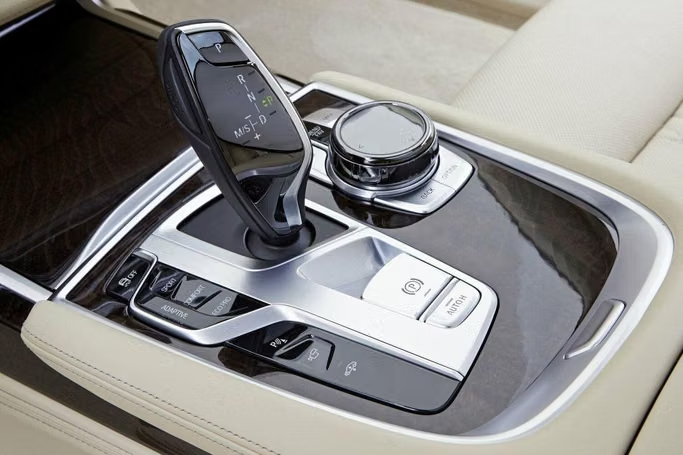
BMW 7 Series G12 automatic selector. Its appearance does not identify the precise gearbox version. Model photograph in the catalogue.
For uneven engine running and reduced performance, see “The B58 turbo engine in the BMW 740i and 740Li G11/G12”. It examines the early B58’s boost system and related checks, helping distinguish engine problems from transmission symptoms.
Should lifetime transmission fluid be changed?
The absence of a scheduled change does not mean fluid condition can be ignored. The 2017 US BMW maintenance booklet lists the automatic among assemblies with long-term fluids. Separately, ZF recommends replacement after 150,000 km, with shorter intervals potentially appropriate for high temperatures, heavy loads or unknown previous use. This is the transmission manufacturer’s recommendation, not a universal BMW interval for every market.
ZF specifies LifeguardFluid 8 for the 8HP50 and 8HP75 applications discussed here. Select the pan, filter and seals for the actual unit. The ZF service instructions require precise level adjustment; the relevant procedure uses a fluid-temperature window of 30–50°C. Drained quantity and total transmission capacity are different figures. ZF does not permit additional oil additives.
Which engine consumables should also be considered?
For the early B58, the US BMW service reference specifies 0W-20 engine oil meeting BMW Longlife-14 FE+*. A synthetic oil with confirmed compliance is suitable; “synthetic” alone does not establish approval. Check other versions and markets separately rather than choosing a thicker oil solely because the weather is hot.
* Longlife-14 FE+ is a BMW engine-oil specification; 0W-20 identifies the viscosity grade.
For the US 740i in the 2017 document, engine oil and filter follow CBS*. The air filter is due at every fourth oil service and plugs at every sixth: approximately 64,000 and 97,000 km. Inspect the air filter more often in dusty conditions. The cabin filter accompanies every second oil service. Brake fluid has its own CBS deadline. Check coolant level and concentration; repeated loss requires leak investigation.
* CBS: Condition Based Service, BMW’s system displaying the due dates or distances for individual maintenance tasks.
How should a buyer assess the transmission?
When comparing current offers, request evidence of completed work. An invoice saying only “oil change”, without identifying the assembly and product, reveals little about transmission care.
- Drive the car cold and warm, testing reverse, gentle acceleration, slowing down and moving away again.
- Obtain diagnostic results before codes are cleared; inspect the pan, connections and signs of leakage.
- If symptoms occur, request a diagnosis and an itemised estimate for fluid, filter, components and labour.
Conclusion
Early petrol G11/G12 BMW 7 Series models use different versions of the eight-speed ZF 8HP. Base a purchase on the actual transmission’s condition, records and a proper drive. Diagnosis should distinguish internal wear from software, engine or transfer-case faults before a replacement gearbox is approved.