


Is the BMW 740i fast? 7 Series acceleration and version differences
BMW 7 Series
BMW 7 Series•
•12 views
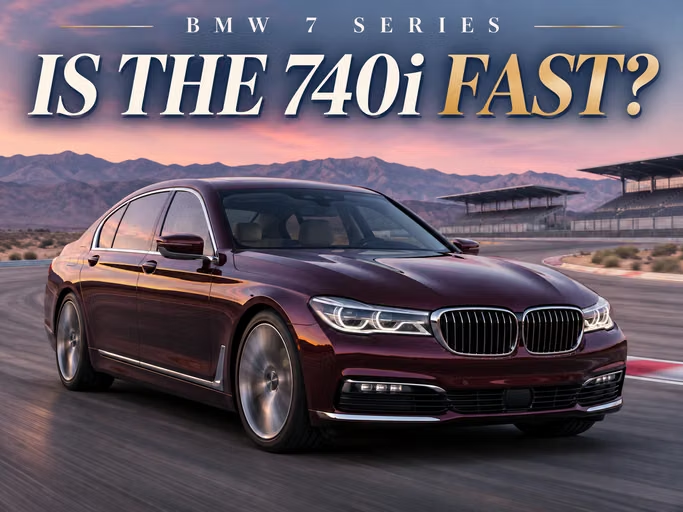
Editorial illustration. The vehicle and road scene are illustrative, depicting a pre-facelift G11/G12-generation 7 Series.
The BMW 740i is a fast luxury saloon, but one acceleration figure cannot describe every model year. At the sixth generation’s launch, BMW quoted 5.5 seconds to 100 km/h for the 740i and 5.6 seconds for the long-wheelbase 740Li. These are manufacturer figures for specific versions, rather than a promise for every used 7 Series.
For a UAE buyer, identifying the car behind the advertisement matters more: standard or long wheelbase, rear-wheel or all-wheel drive, original or updated powertrain. This article focuses on the G11/G12, with the later G70 providing context. The practical question is what performance the owner receives and which differences justify paying more.
How quickly do the BMW 740i and 740Li reach 100 km/h?
For the rear-wheel-drive G11/G12 versions discussed here, the reference is 5.5–5.6 seconds. BMW’s 2015 launch documentation associates those figures with 240 kW, or 326 metric horsepower, and 450 Nm. The document labels its performance figures as provisional.
The updated 740i and 740Li in the 2019 UK technical specification produce 250 kW, or 340 metric horsepower. However, their quoted 0–62 mph times, approximately equivalent to 0–100 km/h, remain 5.5 and 5.6 seconds respectively. Another 14 metric horsepower therefore does not automatically mean a noticeably quicker launch.
These numbers do not cover every xDrive* derivative or market. An individual offer needs its own specification and production date. First registration does not necessarily identify the technical update, while replacement exterior parts can make a visual comparison misleading.
* xDrive is BMW’s designation for its all-wheel-drive system.
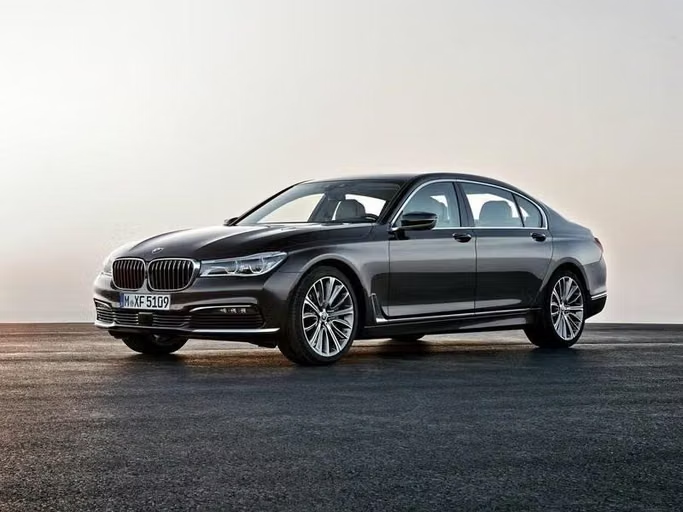
A pre-facelift, long-wheelbase G12 BMW 7 Series. Model photograph in the catalogue.
Why is 0–60 mph different from 0–100 km/h?
The finishing speeds differ: 60 mph is approximately 96.6 km/h. The car still has another 3.4 km/h to gain, so identical times in the two formats do not describe identical acceleration. Nor is there a universal correction of a few tenths: that depends on acceleration near the end of the measurement.
Compare the same discipline first, then the testing conditions. A video with passengers, a sloping road and an unexplained timer is not interchangeable with a manufacturer’s specification. Even a satellite-based measurement needs its test method explained. When a seller supplies only an impressive number, requesting the original result is more useful than debating tenths from a dashboard recording.
Is the G70 BMW 740i significantly faster?
In its initial international specification, the power increase is more striking than the change in acceleration time. The April 2022 G70 documentation lists the 740i at 280 kW, or 380 metric horsepower, with a 0–100 km/h time of 5.4 seconds. This is an early specification, not a universal figure for every subsequent model year.
Moving from 5.6 to 5.4 seconds saves 0.2 seconds, approximately 3.6% of the original time. That calculation describes only this measurement. It says nothing about rolling acceleration, cabin refinement, electronic systems or equipment. Buying the newer generation solely for those two tenths is a narrow way to assess an expensive saloon.
When reviewing current offers, separate the generations before comparing price, specification and condition within each group. A larger power figure in an advertisement does not explain the entire price difference.
Does launch performance matter more than response on the road?
Both matter, but they answer different questions. Acceleration from rest to 100 km/h is a convenient specification comparison. Response at an existing road speed shows how predictably the car answers the driver’s request when changing lanes or climbing a gradient.
The early 740i delivers its peak 450 Nm from 1,380 rpm in BMW’s launch data. Yet torque alone does not describe the whole acceleration process: the selected gear, transmission response and available grip also matter. An 80–120 km/h time cannot be derived reliably from 0–100 performance or engine output without a separate measurement.
On an agreed test drive, assess smoothness and consistent response within normal, permitted driving conditions. A demonstration that exceeds the speed limit is unnecessary. In a large, quiet saloon, perceived speed may differ from actual speed; traffic conditions and the instruments are better guides than engine noise.
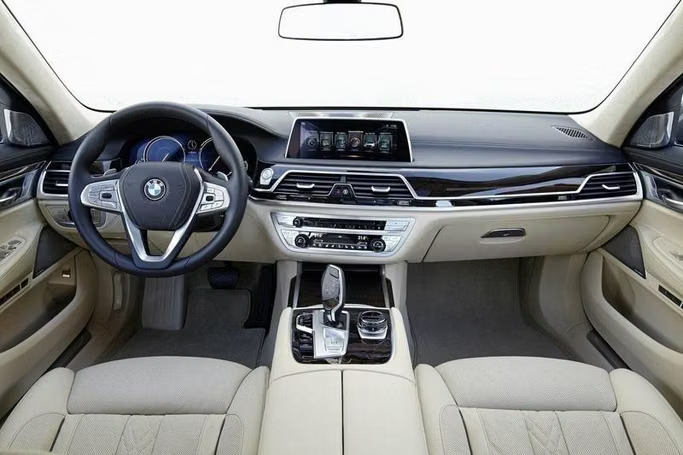
The pre-facelift G11/G12 cabin. Interior styling does not establish a particular version’s power output. Catalogue photograph.
Why might a used 740i fail to match its quoted performance?
A factory figure is not a guarantee for a car with an unknown history. Different test conditions, additional load and mechanical faults require different explanations. One disappointing launch does not prove a failure, while a substantial loss of performance should not be dismissed simply because the car is older.
If acceleration brings hesitation, a dashboard warning or a persistent loss of pull, diagnosis matters more than the stopwatch. Establish whether the symptom appears after warm-up, under what load it occurs and which faults are recorded. A documented workshop assessment tells a buyer more than a claim that the car performs normally for its age.
For pre-facelift 740i and 740Li models, the separate guide to the B58 turbo engine in the BMW 740i and 740Li G11/G12 develops this point. It covers boost, cooling and checks when performance drops. Its technical recommendations should not automatically be applied to the G70 or a different engine derivative.
Should you pay extra for a car claimed to be faster than standard?
Only after establishing what has changed and how the result was verified. A claim about modified engine software is not a measured power output, and high output does not guarantee good condition. Buyers should distinguish factory specification from later modifications and request records of the work.
Compare a modified offer with a standard car using the full financial commitment: purchase price, diagnostic findings and necessary work. A hypothetical AED 10,000 saving ceases to be an advantage if confirmed essential expenses exceed that amount. This is an arithmetic example, not an estimate of BMW repair costs. Paying more for documented condition can be more useful than paying for unverified acceleration claims.
Conclusion
The BMW 740i delivers strong performance in a luxury-saloon package: the rear-wheel-drive G11/G12 versions considered here provide a reference of 5.5–5.6 seconds to approximately 100 km/h. Generation, specification and retained performance determine the individual purchase. Factory numbers help narrow the search; the value of a used 7 Series depends on the seller’s claims being supported by records and the car’s condition.


