How to prepare a BMW 5 Series for sale: a pre-sale checklist
BMW 5 Series
BMW 5 Series•
•3 views

Editorial illustration. Vehicle appearance is illustrative; the equipment and condition of an individual car may differ.
Preparing a BMW 5 Series for sale starts with inspection and paperwork and ends with photography. Reversing that order can waste money on presentation: a buyer will still check the engine, air conditioning and service history. For a reseller, the goal is a clear result from each job, rather than the largest possible preparation bill.
This guide uses the G30 sedan, particularly the pre-facelift petrol 530i, as its example. It separates necessary repairs from cleaning and optional cosmetic work. The figures below are an illustrative budget calculation, not workshop quotations or a promised selling price.
Where should BMW 5 Series preparation start?
Create one list of jobs and rank them. Before booking paint correction, complete these five steps:
- Identify the production year, original market, engine and factory equipment.
- Collect service records, keys and information about previous repairs.
- Check safety items, dashboard warnings and essential systems.
- Obtain separate mechanical and cosmetic quotations.
- Compare the total budget with a realistic selling price.
When reviewing current listings, compare cars of the same generation and similar specification. A diesel, hybrid or six-cylinder 540i is not automatically a price benchmark for a 530i. An advertised price is also not evidence of a completed transaction. Keep several comparable examples and note their mileage, history and stated condition.
Why confirm the engine and market before ordering work?
The 530i badge does not guarantee identical specifications. BMW’s G30 launch information describes the international 530i with a 2.0-litre, four-cylinder petrol engine and 350 newton-metres of torque. However, a BMW bulletin for the United States market lists 2017–2019 530i models with the B46O engine. Specifications and repair requirements should therefore not be transferred automatically between markets.
Check the engine code, production date and equipment against the VIN* and records before ordering parts. An incorrect service item can delay preparation and reduce the negotiating margin. B48 and B46 are BMW petrol-engine family designations; the exact variant still needs confirmation.
* VIN means Vehicle Identification Number, used to identify the car and verify its factory specification.
For an international-market 530i with the B48, see “The B48 engine in the BMW 530i G30”. That article supports a closer engine assessment but does not replace inspection of the individual car.

Appearance is only part of preparation: records should confirm the version and equipment. Model photo from the catalogue.
What should be repaired before the body is polished?
Address confirmed faults affecting safety or normal operation first: brake and tyre problems, leaks, overheating and unstable engine running. Investigate dashboard warnings. Clearing a fault code without fixing its cause does not prepare a car for sale, and a temporarily absent symptom does not prove that it is resolved.
On a turbocharged 530i, ask for cooling-system checks and investigation of leaks or poor response. Do not replace a turbocharger because of a whistle or a guess: establish the diagnosis first. Assess gearbox behaviour both cold and warm, and air-conditioning performance after parking and while driving. Record any defects left unrepaired, disclose them and account for them in the price.
Does the car need a service before sale?
Yes, when its condition or applicable maintenance schedule requires one. A fresh oil change should not substitute for service history. Retain an invoice showing the date, mileage and materials used. Repeating recently documented maintenance solely for the advertisement is usually unnecessary.
BMW’s maintenance guide describes CBS** as a system displaying the need for individual maintenance tasks. Additional operations, including spark-plug replacement, may not have a separate display entry. Check the applicable maintenance plan alongside the vehicle menu. A petrol 530i uses spark plugs; diesel 5 Series glow plugs require assessment under that version’s own diagnostic and maintenance requirements.
** CBS means Condition Based Service, BMW’s system for determining maintenance needs. The linked guide covers the United States market; confirm the intervals applicable to the individual car.
What does the cabin need beyond a basic clean?
Start with mats, seat seams, the luggage compartment and frequently touched surfaces. Remove personal belongings, sticker residue and excessive air fresheners. Choose cleaning methods appropriate to the leather and trim; greasy shine does not demonstrate good condition. Test seat adjustment, windows, climate control and the equipment listed in the advertisement.
A persistent damp smell requires investigation of moisture, rather than masking. Show water marks and damaged trim separately. Before-and-after photographs can document the work and distinguish routine cleaning from interior repairs.
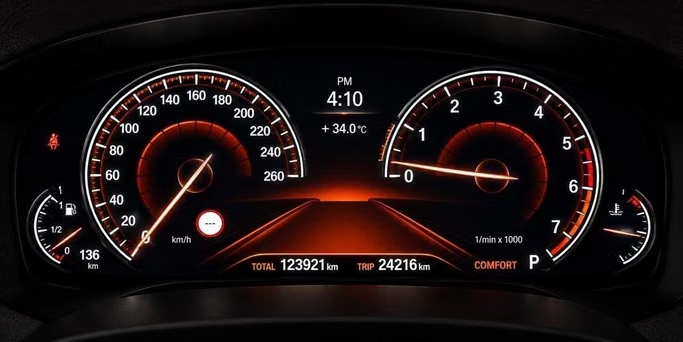
A dashboard photograph shows the displayed mileage and messages; it does not replace diagnostics. Model photo from the catalogue.
When is polishing worthwhile, and when is repair needed?
Assess the paint before polishing. Correction may improve minor surface defects, but it cannot remove dents or damage reaching the underlying material. Ask for a quotation separating cleaning, paint correction and body repairs. This makes it easier to reject work that adds little to this particular car’s presentation.
Repainting every chip to advertise an “immaculate body” is not essential. A small defect can be photographed clearly and reflected in the price. If a panel was repaired, retain the records and photographs. A buyer needs an understandable repair history, rather than a promise of perfection that a paint-depth inspection may contradict.
How can a reseller judge whether cosmetic preparation pays?
Compare the expected price improvement with the additional costs, allowing separately for time. Suppose a car is expected to sell for AED 80,000 without cosmetic work. Preparation costs AED 2,500, and the expected selling price becomes AED 82,000. The AED 2,000 increase leaves the result AED 500 worse than without the work, before any cost of waiting for a buyer.
This is an illustrative calculation, not a BMW market valuation. Raising the asking price is insufficient: the extra amount must be achieved in the transaction. Safety repairs belong in a separate decision; weak cosmetic returns do not justify cancelling them. Set a spending limit for optional improvements and require a revised quotation before increasing it.
Which photographs and details should an advertisement include?
A practical target is 10–12 landscape photographs in even daylight: different exterior angles, front and rear views, cabin, boot, dashboard, wheels and visible defects. This is a completeness recommendation, not a platform requirement. Place images sequentially, each on its own. Filters that alter colour or conceal damage make assessment harder.
State the version, year, mileage, original market, documented maintenance and outstanding issues. List equipment actually fitted instead of saying “full options”. Before the first viewing, have the keys and records ready and arrange access for an independent inspection. The price discussion can then focus on the car’s condition and documented work, rather than photographs alone.
Conclusion
Preparing a BMW 5 Series for sale requires a sensible sequence of checks and spending. Confirm the specification and mechanical condition before cleaning and cosmetic improvements. Records, a clear description and honest photographs help a buyer assess the car and help the seller explain its price without excessive promises.