


BMW 5 Series automatic problems: what fails and how can repairs be avoided?
BMW 5 Series
BMW 5 Series•
•6 views

Article illustration. Vehicle and interior details are illustrative; this is not a diagnostic diagram.
Jerking, delayed engagement and vibration in a BMW 5 Series deserve investigation, but do not automatically mean the automatic needs replacing. The cause may lie in the gearbox, its software, the engine or the all-wheel-drive system. A road test, diagnostic assessment and fluid-level check are therefore a more sensible first expense than a replacement assembly.
This guide covers early petrol G30 530i and 540i models with the eight-speed ZF 8HP50 transmission family. Diesels, the 530e hybrid, M5 and other generations are excluded. It examines warning signs, documented service cases, maintenance in hot conditions and published workshop cost guides in Dubai.
How do you identify the transmission in a particular car?
Start with factory information against the VIN*, engine and production date. The model catalogue distinguishes G30 cars from earlier saloons, but selector appearance and a 530i badge cannot identify the unit. Early US 530i models use B46 engines, while European versions use B48; the 540i uses B58. This distinction matters when checking service bulletins.
* VIN: Vehicle Identification Number.
The 8HP50 is a conventional hydraulic automatic. A torque converter transmits drive when moving away, while friction elements engage the gears. The mechatronic unit* controls shifts. These are separate diagnostic areas: a control fault does not establish worn clutches, and fresh fluid cannot rebuild a damaged component.
* Mechatronic unit: an assembly combining electronic control with hydraulic gear-selection components.
What should be checked when the gearbox jerks or slips?
First distinguish fluid leakage, pressure-control faults and internal wear. Public data do not establish the single most frequent failure across all UAE G30 cars. This table identifies investigation routes, rather than ranking failure rates.
| Symptom | Possible fault area | What to establish |
|---|---|---|
| Oil traces, delayed engagement | Pan, seals or connections; insufficient fluid | Locate the leak and check level using the specified procedure |
| Harsh shifts | Pressure control, valves or software | Read faults and compare live data during a drive |
| Revs rise without matching acceleration | Friction elements or insufficient pressure | Confirm slip rather than authorising repairs from a sensation alone |
| Shudder at steady speed | Torque-converter lock-up or other driveline components | Separate engine, wheel and propeller-shaft causes |
Stop driving if the car loses drive, leaks significantly or displays a warning prohibiting further travel. Repeated acceleration “to test it” may increase damage. Save the diagnostic report before clearing codes: it can preserve temperature and operating conditions associated with the fault.
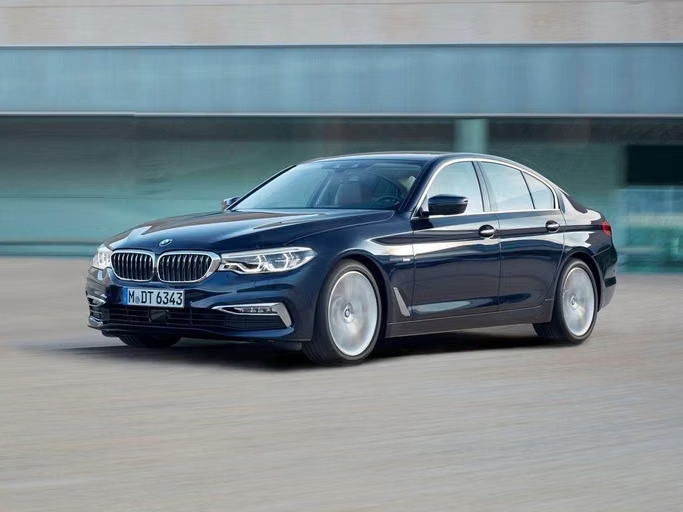
Pre-facelift BMW 5 Series G30. Factory information establishes the actual equipment and drivetrain. Model photograph in the catalogue.
Can programming resolve the problem?
Yes, when the car and symptoms match a documented service case. BMW’s reverse-to-neutral bulletin includes early G30 models with B58 and 8HP50. It identifies an engine-software error and prescribes programming. BMW explicitly states that replacing parts will not resolve that particular situation.
However, a bulletin found online cannot automatically explain a hot-weather fault. A separate 530i cold-weather bulletin applies to specified cars at approximately −21 to 0°C. It does not automatically explain summer jerking in Dubai. The workshop must establish applicability and confirm its diagnosis.
When does the cause lie outside the automatic?
Jerking during slow turns on an xDrive* car calls for tyre and transfer-case checks. BMW documents this scenario for the G30 among other models, identifying incorrect or unevenly worn tyres and transfer-case oil as possible causes. The transfer case is separate: changing automatic-transmission fluid does not service it.
* xDrive: BMW’s all-wheel-drive designation. The transfer case distributes drive between the axles.
Uneven engine running can also feel like transmission judder. For a B48-powered 530i, see “The B48 engine in the BMW 530i G30”. That article covers boost, cooling and checks for reduced performance. Applicability to the US-market B46 must be established separately.
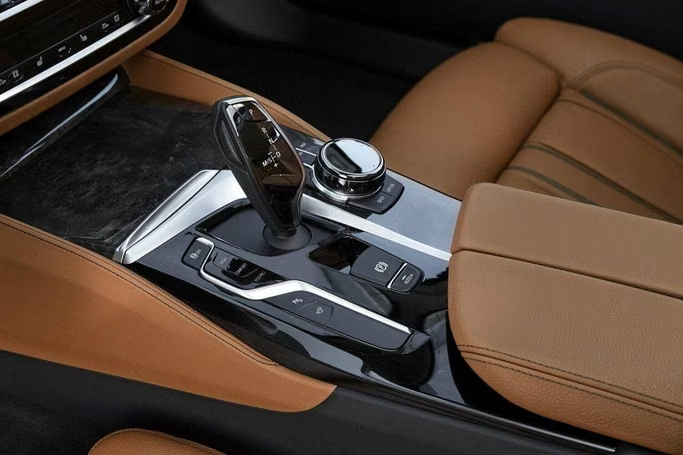
BMW 5 Series G30 automatic selector. Its appearance does not establish transmission condition. Model photograph in the catalogue.
When should the fluid be changed, and which product is required?
The 2017 US BMW maintenance booklet treats the automatic as an assembly with long-term fluid. Separately, ZF recommends an oil change after 150,000 km; high temperatures, heavy loads or unknown previous use can justify shorter intervals. This is not a universal BMW service interval for every market.
The 8HP50 discussed here uses ZF LifeguardFluid 8, a dedicated semi-synthetic transmission fluid. Match the pan and filter to the actual unit. ZF’s instructions require precise level adjustment at the specified temperature, 30–50°C for the relevant check. Additional additives are prohibited. A universal product described merely as suitable for “eight-speed automatics” is insufficient without confirmation of approval.
How much do servicing and repairs cost in Dubai?
The budget depends on the confirmed fault. These published guides from two independent workshops were checked on 26 November 2026. They are neither market averages nor quotations for an individual G30.
| Work | Guide, AED | Source and conditions |
|---|---|---|
| Computer diagnostics | 250 | German Car Repair Dubai; fault codes and live data |
| ZF 8HP fluid and filter service | 800–1,500 | Same workshop; confirm the kit contents |
| Valve-body / mechatronic repair | 2,100–5,775 | Mechanics; published range including 5% tax |
| Transmission rebuild | 5,250–12,600 | Mechanics; published range including 5% tax |
The diagnostic and servicing prices and 8HP repair guides cover different work. Clarify tax inclusion for the first two rows. Always request parts, fluid specification and quantity, labour, warranty and any programming requirements separately. A complete replacement gearbox is not priced in this table.
How can you reduce the risk of another fault?
Prevention starts with correcting leaks and servicing properly. Effective cooling and avoiding prolonged overload matter in hot conditions; ZF specifically warns that high operating temperatures accelerate fluid ageing.
- Avoid hard acceleration with a cold powertrain; do not hold the car on a slope using the accelerator.
- Monitor leaks, match servicing to the transmission identification and keep invoices specifying the fluid and filter.
- When comparing cars, ask about overheating, previous repairs and engine-software changes: increased torque alters transmission loading.
Engine servicing remains a separate task. The BMW reference for early US applications specifies synthetic 0W-20 oil meeting Longlife-14 FE+* for B46/B58 engines. Check the applicable documentation for a B48 from another market. Replace the engine-oil filter with the oil; do not increase viscosity solely because the weather is hot.
* Longlife-14 FE+ is a BMW oil specification; 0W-20 is the engine-oil viscosity grade.
Under the 2017 US schedule for ordinary petrol 530i/540i models, the air filter is due at every fifth oil service, spark plugs at every sixth and the cabin filter at every second; inspect the air filter more often in dust. Brake fluid has its own service deadline. Check coolant level and concentration, repair leaks and restore the fill using the applicable procedure.
Conclusion
When comparing current offers, assess records and actual behaviour rather than a promise of a trouble-free gearbox. Jerking in an early BMW 5 Series can have several causes. A confirmed diagnosis, correct fluid and correction of the underlying fault are more useful than replacing an expensive assembly as a precaution.


